
Story #072
Poetry Before Dishes

Max J Miller

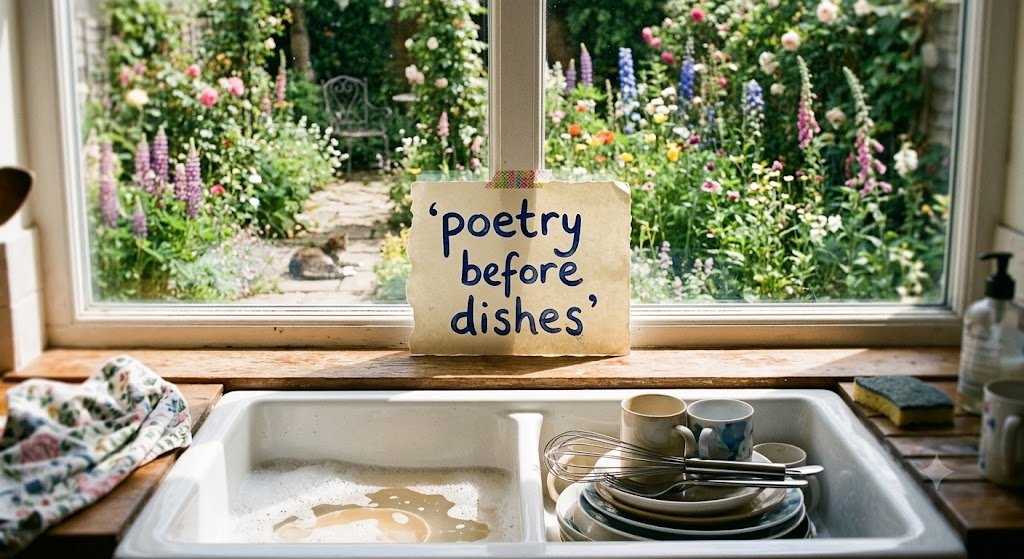
There was a small sign above the kitchen sink at the writing retreat in North Carolina. Hand-lettered, a little crooked, clearly made by someone who wasn’t trying to impress anyone. It said: Poetry before dishes.
I noticed it the first morning, coffee in hand, before I’d said a word to anyone. Kim hadn’t put it there as decoration. She told me she put it there as a rescue line. A small, daily reminder that the sink would always refill itself with things to do, and that beauty and attention were not scheduled for whenever the sink finally emptied. They were available now, mid-stack, dishes, and all.
I’ve been thinking about that sign for days. Not because I have a dish problem — though I do — but because it names something I didn’t have words for until I saw them written above someone else’s sink.
Here’s the thing nobody tells you about retirement: you don’t retire from doing. You retire from a job. The compulsive habit underneath the job — the one that made the job feel urgent in the first place — comes with you. The calendar empties out, and for a while, that feels like freedom. Then you notice the calendar was never really the problem. The problem is a mind that doesn’t know how to be without a task attached to justify it. Empty afternoons start to feel less like spaciousness and more like an indictment. Surely there’s something you should be doing with this.
I’ve caught myself, more than once, in the middle of doing genuinely nothing — sitting on a porch, no phone, no agenda — feeling guilty about it. Not guilty about anything in particular. Just guilty in the abstract, the way you feel when an alarm you can’t locate keeps going off somewhere in the house. That alarm is the doing-mind. It doesn’t retire when you do. It just changes what it’s nagging you about.
I want to push back on something, though, because I think we’ve inherited a lazy idea of what “being” even means. We tend to hear it as the soft option — the yoga-retreat version, something you do instead of the real work of life, a rest stop on the way back to doing. Heidegger, who dedicated his life to studying being, didn’t see it that way. For him, being-in-the-world wasn’t passive at all. It was closer to a confrontation. To actually be — to stop managing your existence from a safe distance and instead meet it directly, without the usual buffer of tasks and roles and distraction — takes something. It takes courage, maybe more courage than doing does, because doing lets you stay busy enough to avoid the question of what any of it is for. Being doesn’t let you look away.
So this isn’t a piece about slowing down. It’s a piece about what you find when you stop running long enough to actually arrive somewhere.
Here’s what I’ve been practicing, badly and inconsistently, but practicing: noticing a thought, a sensation, an emotion, without becoming it. A flash of irritation shows up — at traffic, at a headline, at my own body doing something it used to do more easily — and instead of immediately becoming the irritated person, riding it wherever it wants to take me, I try to notice it the way you’d notice weather. There’s a storm moving through. Not: I am the storm.
It sounds small. It isn’t. Almost everything that runs my day — my mood, my reactions, the story I tell myself about how the day is going — runs on the assumption that whatever I’m feeling right now is simply true, simply me, requiring no examination. Noticing without becoming is the crack in that assumption. It’s the difference between being swept out by a current and standing on the bank watching the current go by. Same river. Very different relationship to it.
And here’s what I actually wanted to tell you, the thing underneath all of this: I don’t think you can really meet another person from inside the doing-mind. You can manage them from there. You can be useful to them, responsive to them, even kind to them, in a functional sort of way. But meeting someone — the kind of moment where something actually passes between two people — happens somewhere else. It happens from the space of being, not the space of doing.
The doing-mind is a survival tool. It scans for problems, tracks obligations, keeps score. Useful for getting through a to-do list; not built for connection. It’s very hard to be fully with someone while part of you is still running the errands. Being is what clears the channel. In the here and now of it — no task pending, no story running — there’s a kind of stillness that isn’t empty. It’s actually where the creativity comes from, and the consciousness, and, I’m increasingly convinced, the connection. Not despite doing nothing. Because of it.
I don’t think this is a call to abandon the dishes. Somebody has to do them, and it isn’t going to be poetry. But maybe the sign had it right in a way I’m still working out: not dishes are bad and poetry is good, but poetry doesn’t wait its turn. It’s available now, mid-stack, mid-errand, mid-whatever-you’re-currently-convinced-is-urgent.
So here’s what I’m sitting with, and maybe you will too: what in your life is the dishes, and what is the poetry — and are you sure you’ve sorted them correctly?
Shine,

Subscribe to the Newsletter
Join Max J Miller Blog and receive new online content directly in your inbox.
Recommended for Your Journey
Discover more inspiring reads that support your journey toward growth, purpose, and emotional well-being.

[061] The elders the culture has been missing
- Max J Miller

[034] Finding God in forbidden love—then facing intervention
- Max J Miller

[011] – Why Writing Advice is Mostly Wrong
- Max J Miller

[068] Somewhere Around the Michigan Border
- Max J Miller
[047] Finding Your Voice (It’s Already There)
- Max J Miller

[008] – Charlie Hustle, Street Theater, and the Soul of Story
- Max J Miller