
Story #061
The Elders the Culture Has Been Missing
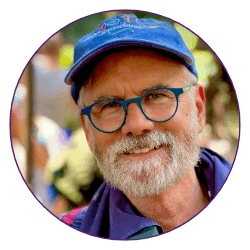
Max J Miller

I’m sitting in a room with about a hundred men.
Not just any room — this is The Big Tent, a gathering of leaders engaged in men’s work of all kinds. Facilitators, guides, teachers, mentors. Some of them have been doing this work for forty years or more. This is our second annual gathering, and as I look around, something is settling in me that I can’t quite name yet.
Most of these men are older. And it shows — not in the way our culture means when it says that, as something to apologize for or work around, but in the way that matters. It shows in how they hold themselves. In how they listen. In the quality of silence they bring to a room before they’ve said a word.
When they speak, pearls drop. And they’re not performing wisdom. They’re not performing anything at all. They epitomize authenticity and vulnerability.
They are insightful without arrogance. Powerful and yet gentle. They carry presence and gravitas, and then, just when the weight of it might become too much, they’ll say something that makes the whole room laugh. They know exactly how to do that. They’ve earned it.
At least a handful of these men could be the poster image for what the ancient traditions called the Wise Elder — the archetype our culture has quietly starved itself of, without quite knowing what it was losing.
As I look around the room, I feel it clearly for the first time: these are the elders the culture has been missing.
I find myself wondering what the earning looked like. What it actually costs a man to arrive here — at this particular combination of depth and lightness, of authority worn so easily it’s almost invisible. You don’t get this from a book or a weekend retreat. You get it from decades of showing up, falling short, losing things you loved, and choosing to keep going anyway. You get it from a life that has been, as Wordsworth said, felt in the blood, and felt along the heart.
Something happens in a long life, if you let it. The noise separates from the signal. The things that seemed so urgent turn out to be decorative, and what was quietly essential all along steps forward.
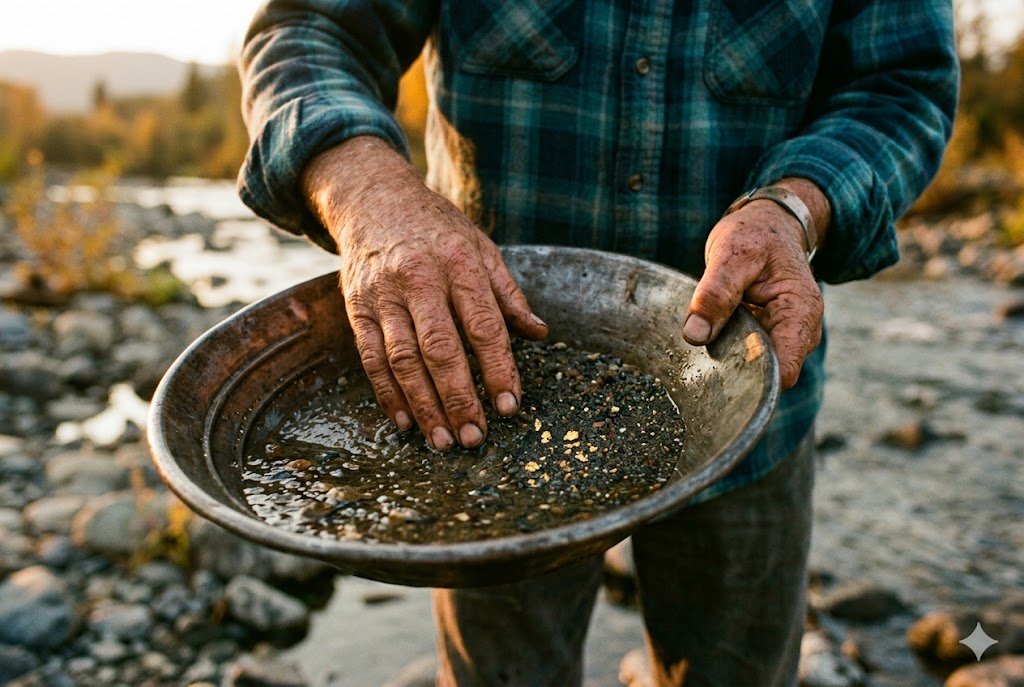
Elders have had time to sift. They’ve run the whole catalog of human ambition through their hands — achievement, ideology, certainty, status, righteous causes won and lost — and watched most of it slip through their fingers like sand. They’ve watched enough movements rise and collapse into their own contradictions to develop a kind of narrative immunity. They can hear a political position and recognize not just the argument, but the wound underneath it. They’ve been on enough sides of enough arguments to know that the person across the divide is not evil. They’re usually just earlier in the story.
And because their own identity is no longer on the line — because they’ve already survived many of the losses the young most fear, already made peace with their own contradictions — they can listen without needing to win. They can sit with ambiguity without panicking. They carry a longer memory than any algorithm, and they think in generations rather than news cycles. They’ve broken the habit of asking, “Who wins this argument?” Now they ask, “What kind of world am I leaving?” That is a bridge builder’s question.
But perhaps the deepest qualification is this: at the bottom of the sieve, something catches the light. A glint. Almost startling in its simplicity. It is the face of someone who saw them truly. The hand held in a dark moment. The conversation that made them feel, for once, that they were not alone. This is the gold — Not a philosophy about human connection, however eloquent. Not a theory of belonging, however convincing. This is the thing itself, recognized at last for what it always was: the only element in a human life that never loses its value, no matter how long you work the sieve.
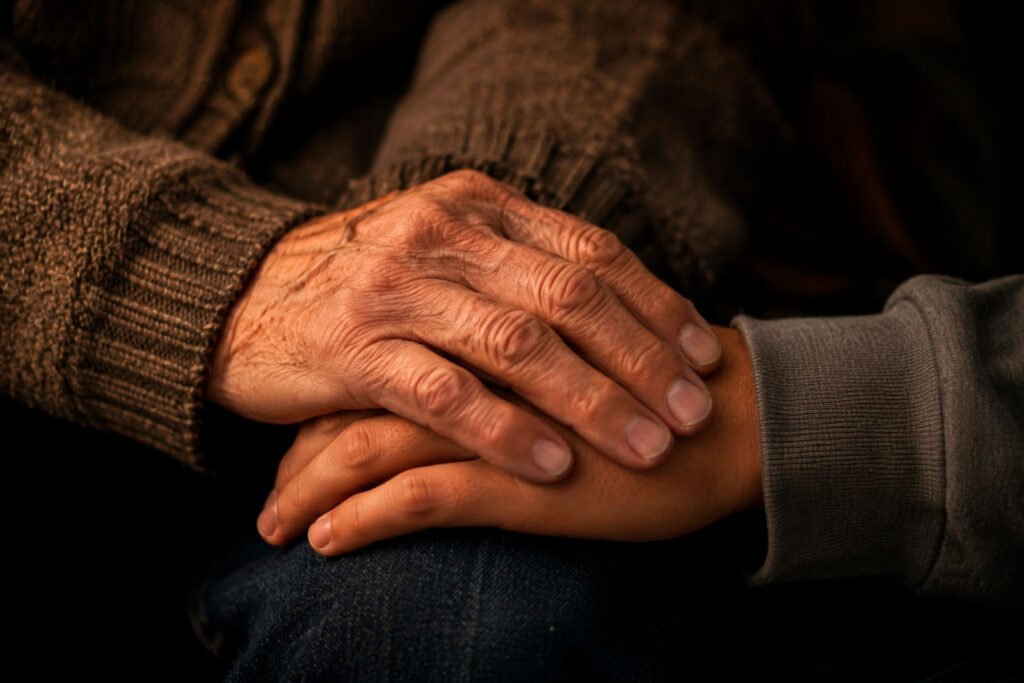
This is what elders bring to a fractured world. Not more debate. Not better arguments. But the lived knowledge that beneath every division, beneath every competing ideology and calcified grievance, the gold was always there. They aren’t constructing bridges so much as brushing away the sediment to show us the ground we were always standing on together.
This is where the elder’s role takes an unexpected turn — and deepens.
The temptation, when we look at a fractured world, is to frame the problem as division and the solution as bridge-building. Bring the sides together. Find the common ground. Reduce the conflict. These are worthy impulses. But they still accept the premise. They still treat separation as the fundamental reality, and connection as something we must laboriously construct across the gap.
But what if the elder’s work isn’t to fix the division — but to help people see through the illusion of separation itself?
This is a different kind of work entirely. Not engineering, but revelation. Not construction, but unconcealment. The elder doesn’t build the bridge so much as lift the fog to show that the two shores were never as far apart as they appeared — that beneath the noise of competing ideologies, beneath the grievance and the fear and the performance of certainty, something has been quietly present all along, waiting to be recognized.
We are already connected. That is not a hope or a goal. It is the hidden truth that the sifting reveals.
The twelve-step traditions understand something profound about this. They recognize that the opposite of addiction is not sobriety — it’s connection. The wound at the heart of addiction is not chemical. It is the unbearable experience of being alone, unseen, cut off from the living web of human belonging. And the medicine — deceptively simple, almost embarrassingly so — is presence. Keep coming back, they say. Not because the meetings are entertaining, but because connection is the balm that heals the wound that substances were only ever trying to numb.
What is true of addiction is true of our cultural moment. The rage, the tribalism, the need to reduce every complex human being to an enemy or an ally — these are symptoms of the same wound. We have forgotten, or been convinced to forget, that we belong to one another. That the separateness was always the illusion.
And this is where the elder becomes something more than a wise commentator on the human condition. The elder becomes the sieve — and the gold itself. Not merely pointing toward connection as an idea, but being the experience of it. Creating, by their presence, the felt sense of what it means to be truly seen. To be met. To discover, perhaps for the first time in a long time, that you are not alone in the room.
This is the irreducible gift that no technology can replicate and no algorithm can deliver. You cannot download the experience of being witnessed by someone who has earned their wisdom through genuine living. You cannot stream the feeling of sitting across from a person who has survived what you fear, integrated what you’re still fighting, and arrived — not at certainty, but at peace.
The elder doesn’t argue you out of your separateness. They make you forget it, for a moment, in the warmth of genuine contact. And in that moment, something is revealed that was always true: the gold was never buried. It was only waiting for someone to hold up the light.
The Cultural Moment We Are In
We live in a time of manufactured separation. The algorithms that govern our attention are not neutral. They are optimized, with breathtaking efficiency, for outrage — because outrage keeps us scrolling, and scrolling keeps us consuming. Every day, the machinery of our digital lives works to convince us that the person on the other side of the divide is not merely wrong, but dangerous. Not merely different, but a threat to everything we love.
And it is working.
We are more sorted, more siloed, more suspicious of one another than at any point in living memory. We have confused our opinions for our identities, our tribe for our family, our echo chamber for reality. We have forgotten that the person we’ve been taught to fear is also someone’s child, someone’s parent, someone carrying a wound they haven’t found words for yet.
Into this moment, the elder walks.
Not with a solution. Not with a program or a platform or a perfectly crafted message. But with something rarer and more subversive: a life that has already been through the fire and come out the other side. A presence that says, without needing to announce it, I have held the contradictions you are still fighting, and I am still here. Come a little further. I’ll show you what I found.
Inviting the Elders In
The men I sat with at The Big Tent are not famous. Most of them will never be. They don’t have television shows or viral platforms or blue checkmarks. What they have is something the digital age cannot manufacture and cannot replace: the authority of genuine experience, worn lightly, offered freely, in service of the next generation’s becoming.
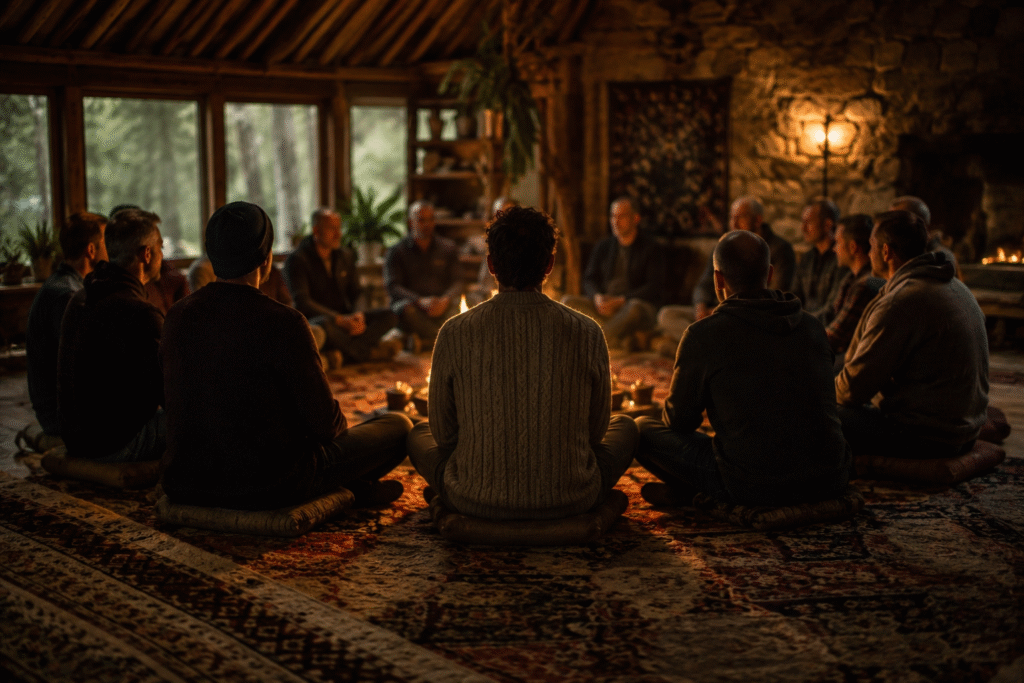
They are proof that it is possible to arrive at a place beyond the illusion — not by escaping life’s hardness, but by going all the way through it. By sifting. By losing what needed to be lost. By discovering, at the bottom of the sieve, the glint of what was always real.
Our culture is starving for this. Not for more information — we are drowning in information. Not for more debate — we are exhausted by debate. We are starving for wisdom. For the lived testimony of people who have traveled further down the road and turned back to say: it’s not as bad as you think. And it’s more beautiful than you can imagine from where you’re standing.
We are starving, most fundamentally, for the experience of connection itself. To be in a room — a real room, or even a metaphorical one — where the pretense drops, the performance stops, and two human beings meet each other on the ground they were always sharing.
A Closing Thought
The elders are not waiting to be discovered. They are already here — in your family, your community, your circles of work and friendship — carrying decades of sifted wisdom that the culture has largely declined to ask for. The question is whether we will create the conditions for that wisdom to be heard. Whether we will build, or restore, the kinds of spaces where elders are not merely tolerated but genuinely sought. Where their hard-won knowledge of the gold is treated not as nostalgia but as medicine.
Because that is what it is. In a world convinced of its own fragmentation, the elder who has seen through the illusion of separation is not a relic. They are not a curiosity or a comfort. They are among the most needed people alive.
The Big Tent showed me that. A room full of men who had done the sifting. Who had found the gold. Who knew, in their bones, that the opposite of our cultural isolation is not a policy or a platform.
It’s connection. It always was.
Keep coming back.
Shine,

Subscribe to the Newsletter
Join Max J Miller Blog and receive new online content directly in your inbox.
Recommended for Your Journey
Discover more inspiring reads that support your journey toward growth, purpose, and emotional well-being.
[054] What Is “True” About Your Life?
- Max J Miller
[029] Alignment: Finding Common Ground Without Agreement
- Max J Miller
[026] Celebrating Six Months of The Wisdom Wayfinder!
- Max J Miller
[002] – The Surprising Seed of Wisdom
- Max J Miller
[048] Subtract to Find Your True Voice
- Max J Miller

[021] – When FOMO Saved My Life
- Max J Miller