
Story #071
What Shape Is The Pain?
Max J Miller

I came to the mountains of North Carolina to write.
To think. To step away from the familiar distractions and duties of home and find some uninterrupted space for the work that matters most to me.
The aches and pains came with me.
This shouldn’t have surprised me. The chronic inflammation that accompanies my kidney condition doesn’t check my itinerary before deciding where to show up. It packed itself quietly alongside the notebooks and the meditation cushion and settled in like an uninvited houseguest who knew perfectly well he wasn’t welcome.
And so the writing retreat became, among other things, a retreat into the very questions I’d come to write about.
What do we do when we’re practicing faithfully and life keeps changing anyway?
What do we do when the boulder we’re carrying doesn’t care that we’ve come to the mountains to set it down?
The Nature of Impermanence — and Why Understanding It Isn’t Enough
We tend to encounter impermanence as a concept. A truth to be recognized, nodded at, and filed away. Speaking for myself, the little voice in my head concurs: Yes, everything changes. Yes, nothing lasts. Yes, I know.
And then I spend the rest of the day fighting the things that are changing.
Stephen Batchelor — whose work has shaped my thinking more than almost any other contemporary writer — draws a distinction in After Buddhism that stumped me the first time I read it. He distinguishes between understanding impermanence and dwelling in it. Between holding a concept and inhabiting a dimension of existence.
He writes of what the Buddha called emptiness — not as a philosophical position but as a way of being in the world:
“To dwell in emptiness brings us firmly down to earth and back to our bodies. It is a way of enabling us to open our eyes and see ordinary things as though for the first time. As the Buddha instructed his student Bāhiya, to live in such a way means that ‘in the seen, there will be only the seen; in the heard, only the heard; in the sensed, only the sensed.'”
And then this sentence I keep returning to:
“To dwell in such emptiness does not mean that one will no longer suffer. As long as one has a body and senses, one will be prone to the anxiety that comes with being a conscious, feeling creature made of flesh, bones, and blood.”
There it is. The practice doesn’t make the pain go away. It doesn’t resolve the uncertainty, restore the kidney donor, or quiet the inflammation. It does something quieter and more radical: it changes our relationship to the reality we’re already living inside.
The chronic condition in my body isn’t an obstacle to this practice. It’s the practice itself, arriving without an invitation, asking whether I can meet it the way Batchelor’s Buddha met everything — with full, undefended presence.
What Shape Is the Pain?
A few days into my retreat, I visited a skilled acupuncturist who works in the area. I left her table feeling genuinely lighter — the kind of relief that makes you wonder why you waited so long.
The next morning, I went for a walk. Somewhere along the trail, the familiar ache returned to my shoulder and arm, moving back in with the casual confidence of something that knows it belongs there.
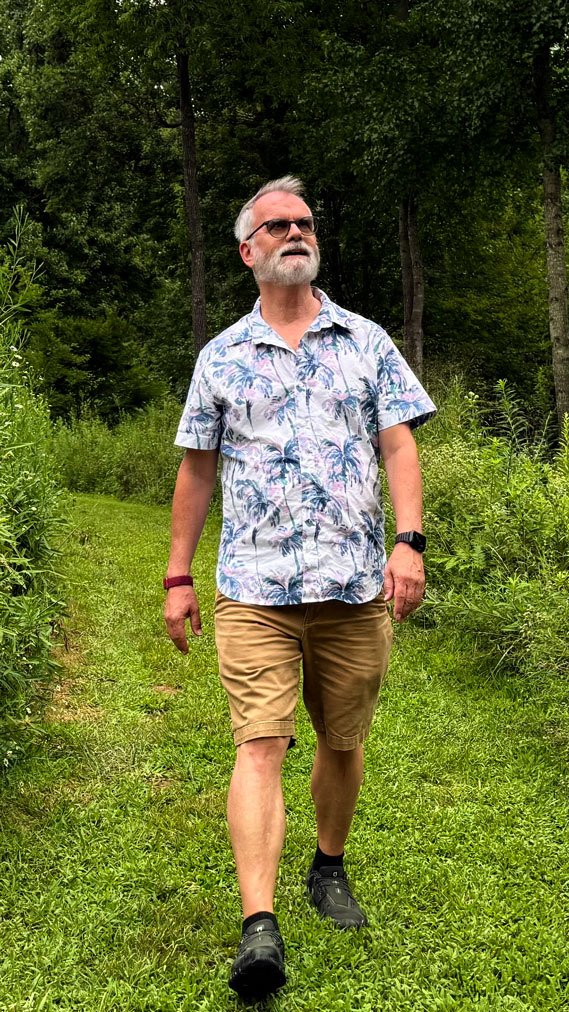
I stopped. I massaged the shoulder. I stretched the arm slowly, carefully, the way you’d coax something reluctant rather than force something resistant. I breathed — deliberately, deeply — into the pain rather than away from it.
And then I remembered a practice I’d encountered years ago and hadn’t reached for in a long time.
I asked the pain a question.
What shape are you?
I stayed with it. Waited. Something angular, I thought. Irregular. Like a stone with uneven edges.
What color are you?
A dull orange. Somewhere between amber and rust.
I know how this sounds. I’m a writer, not a mystic — though the longer I live, the less confident I am in that distinction. What I can tell you is what happened next.
By turning toward the pain with curiosity rather than bracing against it with resistance, something in my experience shifted. The pain didn’t disappear. The inflammation didn’t reverse. But as my resistance lifted — as I stopped spending energy on the fight — the pain seemed to intrude less into my consciousness. It was still present. It had simply lost its grip on my attention.
When I let it fully be expressed, it seemed to let me be.
This, I think, is what Batchelor means by dwelling. Not a meditative state achieved in ideal conditions. A man on a mountain trail, massaging his shoulder, asking his pain what color it is. Brought firmly down to earth. Back to his body. Seeing his ordinary circumstance as though for the first time.
One Must Imagine Sisyphus Happy
Albert Camus published The Myth of Sisyphus in 1942 — in the middle of a world war, in an occupied country, at a moment when the question of whether life was worth living was not merely philosophical.
His answer was built around one of the oldest stories in the Western tradition. Sisyphus, condemned by the gods to roll his boulder up a hill for eternity, watch it roll back down, and begin again. Forever. Without end.
Camus’s radical move was to look at Sisyphus — really look at him — and conclude that he was happy.
Not happy despite the struggle. Happy within it.
“The struggle itself toward the heights,” Camus wrote, “is enough to fill a man’s heart.”
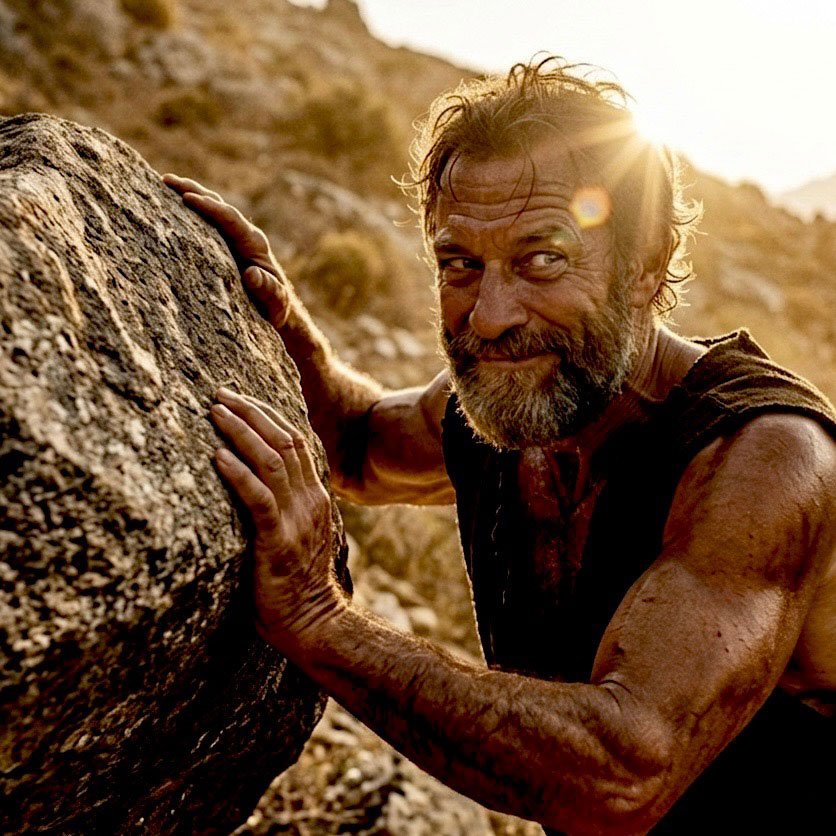
What Camus saw in Sisyphus wasn’t resignation or defeat or the grim endurance of someone who has simply run out of alternatives. He saw aliveness. The boulder demands Sisyphus’s full presence — every muscle, every step, every moment of the climb. There is no room for abstraction on the hill. No space for regret about yesterday’s descent or dread about tomorrow’s. There is only this step. This breath. This stone.
The struggle doesn’t diminish Sisyphus. It wakes him.
This is the insight I find most extraordinary about Camus’s reading — not that suffering can be endured, but that the full inhabiting of our struggle is itself the experience of being alive. Not a pale substitute for some better life that isn’t available to us. The thing itself. The incomparable, irreplaceable experience of being fully embodied, fully present, fully here.
I think of the kidney transplant I’m waiting for. The donor who stepped forward generously, only to have to step back through no fault of his own. The uncertainty that has no timeline. The inflammation that came with me to North Carolina.
These are my boulders. I didn’t choose them. They are, nonetheless, mine.
And on a mountain trail, asking my pain what color it was, I caught a glimpse of what Camus was pointing at. This isn’t happiness in the greeting-card sense. It’s something older and stranger and more alive than that: the simple, astonishing fact of being here, in this body, on this trail, in this moment — pain and all.
Acceptance Is Not Resignation
I want to address something directly, because I’ve heard the objection and have made it myself.
Acceptance sounds like giving up.
That may be accurate in concept, but not in practice. What I experienced on that trail required more of me than resistance does. Resistance is almost automatic. We brace, we fight, we distract, we bargain. It takes no particular skill or courage to refuse to be where we are.
Turning toward the pain with curiosity — asking it its shape, its color, its texture — that asked something of me. It required presence: the willingness to inhabit rather than escape. It calls upon an inner strength and even courage—not an attribute I often acknowledge in myself.
Far from resignation, or even “letting go,” acceptance is an active stance. Perhaps the most demanding practice available to us in our third act. It doesn’t mean the circumstances are welcome. It doesn’t mean we stop doing what can be done — the stretching, the acupuncture, the medical care, the faithful tending of what is within our influence. It means we stop spending our irreplaceable life force fighting the shape of reality itself.
And here — as I wrote in Issue #68 — the Stoics and the Buddhists are having the same conversation across two and a half millennia. Epictetus knew what was and wasn’t ours to control. Acceptance is what it looks like to actually live that knowledge rather than merely hold it as a concept.
Understanding it isn’t enough. We have to dwell in it.
The Freedom That Waits Inside the Struggle
Sisyphus rolling his boulder is not free from his circumstance. He is free within it. That is a different kind of freedom — quieter, more durable, and available right now without waiting for anything to change.
I came to North Carolina to write about wisdom. I didn’t expect the most useful instruction to arrive as shoulder pain on a mountain trail.
But that is, I think, the nature of this practice. Wisdom doesn’t wait for the convenient moment. Impermanence doesn’t pause while we prepare ourselves to meet it. The boulder is always already in motion.
What we practice — on the meditation cushion, in the difficult conversation, on the trail where the pain comes back — is the capacity to meet what’s actually here. Not the life we planned. Not the circumstances we’d have chosen. This one. The only one we have.
In the seen, there will be only the seen. In the sensed, only the sensed.
When I let the pain fully be expressed, it seemed to let me be.
That’s not a consolation. That’s not the silver lining. That is the freedom that lives inside the struggle — the aliveness that the boulder itself, paradoxically, makes possible.
One must imagine Sisyphus happy.
I’m beginning to understand why.
Where in your life are you spending energy resisting something that isn’t going to change — and what might become available to you if you turned toward it with curiosity instead?
Shine,

Subscribe to the Newsletter
Join Max J Miller Blog and receive new online content directly in your inbox.
Recommended for Your Journey
Discover more inspiring reads that support your journey toward growth, purpose, and emotional well-being.
[009] – Redemption in a Story
- Max J Miller
[002] – The Surprising Seed of Wisdom
- Max J Miller
[049] Your Permission Slip: Three More Lessons on Finding Your True Voice
- Max J Miller
[026] Celebrating Six Months of The Wisdom Wayfinder!
- Max J Miller
[041] Five Stages of Becoming: The Books That Rewired My Year
- Max J Miller
[011] – Why Writing Advice is Mostly Wrong
- Max J Miller