Story #069
The Difference Between Following Rules and Becoming Someone

Max J Miller

In the summer of 1983, I trekked across Europe, including a month studying with Francis Schaeffer at his L’Abri school in the Swiss Alps.
I hoped for the opportunity to meet Shaeffer and to discuss his book How Shall We Then Live?, which traces the interwoven threads of philosophy, theology, and science from Ancient Rome to 1976 (the year of its publication).
The book’s introduction, as well as its title, seemed to suggest that the righteous path forward for a culture facing complex and unprecedented questions was to collectively wrestle with present challenges, informed by our best grasp of all three historical legacies (philosophy, theology, and science).
But as I read on, Schaeffer’s tone shifted. What began as an invitation to wrestle with complex questions gradually became a collection of moral imperatives with political implications.
I sensed that Schaeffer and many of his students were caught up in a web of category errors, presuppositions, and rationalizations disguised as intellectual proofs. Their conclusions seemed to me completely out of character with the words and spirit of Jesus’ teaching.
The intellectual firepower at L’Abri intimidated me from articulating my case, and I left L’Abri disillusioned.
That disillusionment never quite left me.
Over the next couple of decades, I witnessed Schaeffer’s writings providing theological cover for the emerging “Moral Majority” movement, which subsequently developed into the religious right in America.
In the years since my visit to L’Abri, the cultural divide has become a defining feature of our age. While many have grown resigned to this condition of our society, I find myself obsessed with it, like living with a chronic disease. Maybe it’s the middle child in me, but I keep seeking root causes.
One of the most promising diagnostic theories I’ve explored is that many in our culture have confused ethics and morality.
“Aren’t ethics and morality the same thing?” If this question popped into your mind, you are not alone.
I recently came across a distinction that helped me name what I’d sensed at L’Abri but couldn’t articulate…
“While morality requires adhering to the moral codes and precepts of one’s religion or culture, the practice of ethics means to live up to the vision of the kind of person you aspire to be, thereby forming your character.” — Stephen Batchelor, Buddha, Socrates, and Us: Ethical Living in Uncertain Times, page 13
When I read this passage, I saw something I hadn’t seen before about the distinction between morality and ethics.
Do you remember the Be, Do, Have Model popularized by Stephen Covey’s self-help blockbuster, 7 Habits of Highly Effective People? The framework suggests that to achieve desired outcomes (Have), one must first focus on the right actions (Do) based on their character and values (Be).
What I saw in Stephen Batchelor’s framework is that ethics follows Covey’s Be-Do-Have sequence. In ethics, you start with “the kind of person you aspire to be,” and you derive your choices and actions from that “being.” We derive our word ethics from the Greek word Ethos, meaning “character.”
Morality follows the reverse course (Have-Do-Be). You begin with the inherited code of precepts (Have), and if you adhere to them (Do), you are deemed a good person (Be). Follow the rules, perform the rituals, and you earn the designation of ‘good person.’
The great conundrum of morality is that its precepts need to be repeatedly interpreted throughout history to address issues that didn’t exist when the code originated.
And the problem with interpretation is that human beings rarely distinguish our interpretations as such. We think the way we see it is the way it is. We’re baffled that anyone could see otherwise.
Whereas morality seems like a straightforward matter of obedience to a code, ethics is a complex, confusing, and often circuitous journey.
In Buddha, Socrates, and Us: Ethical Living in Uncertain Times, Stephen Batchelor presents these esteemed sages as ethical guides.
Though historical contemporaries, they lived in separate worlds, and their messages likely never intersected in their lifetimes.
Though it sounds like the setup for a joke, I’ve often fantasized about what a conversation between Socrates, the Buddha, and Jesus would look like.
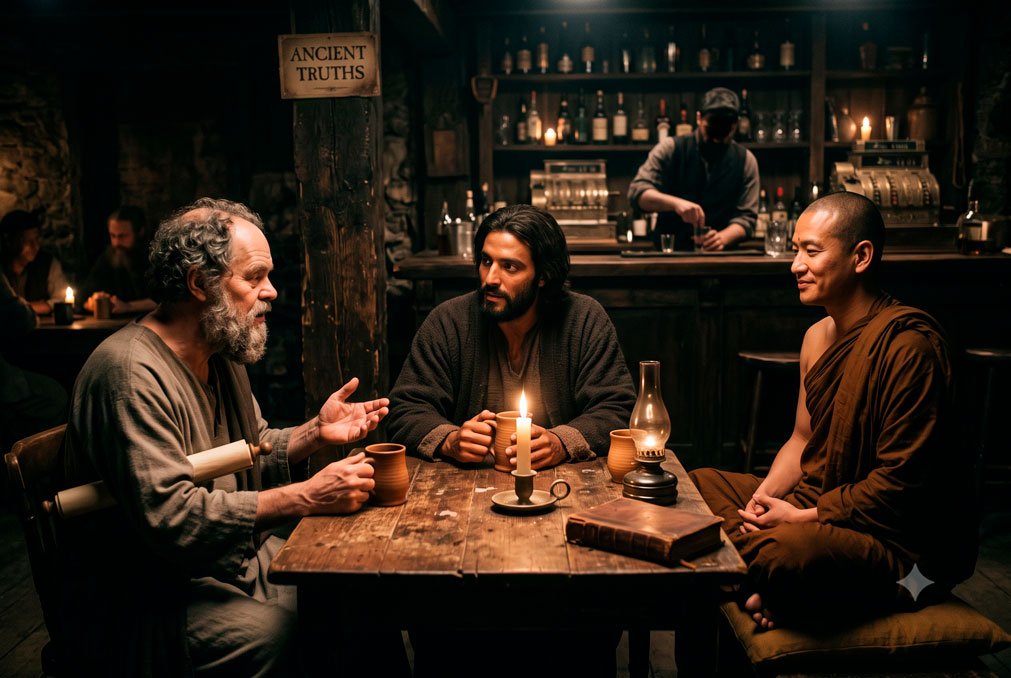
Batchelor illuminates surprising similarities between these two revolutionary teachers. They both employed a questioning approach more than lecturing. They spoke with metaphors and parables using objects and situations familiar to their interlocutors. They shared their insights with anyone who engaged with them.
The essence of the similarity between Buddha and Socrates, according to Batchelor, consists of an “ethics of uncertainty.” Far from instigating moral codes, both challenged and frustrated their followers’ attempts to reduce their teaching into moral doctrines, codes of conduct, and truth claims about the ultimate nature of reality.
Instead, both teachers focused on practical matters of reflection and critical self-evaluation as the pattern of striving toward an ethical life.
While they both gained reputations for great wisdom and insight, the populations eventually turned on them and called for their executions.
Hmm. Where have we seen that pattern before?
“It is better for one man to die for the people than for the whole nation to perish.” – John 11:50
The pattern is worth sitting with. The teachers who offered simple answers and moral certainty drew the largest crowds — and kept them. The teachers who insisted on living the questions, on wrestling with uncertainty, on forming character rather than following codes — they drew devoted followers and dangerous enemies in equal measure.
Perhaps the ethical life has always been the road less traveled. Not because it’s more virtuous, but because it’s harder. It asks more of us than obedience. It asks us to become someone.
In this ongoing inquiry into the nature of wisdom, I find Batchelor’s framing both challenging and hopeful. Challenging because there’s no code to follow, no checklist to complete. Hopeful because the journey itself — the wrestling, the questioning, the aspiring — is the point.
I encourage you to pick up Buddha, Socrates, and Us and read along with me this summer. I suspect it will reward the effort.
Where in your own life have you been following a moral code inherited from others — and what might it look like to ask instead: what kind of person do I aspire to be?
Shine,

Subscribe to the Newsletter
Join Max J Miller Blog and receive new online content directly in your inbox.
Recommended for Your Journey
Discover more inspiring reads that support your journey toward growth, purpose, and emotional well-being.

[064] Beyond Optimism: A Third Act Credo
- Max J Miller

[083] The Meaning of 83: Why Meaning Happens Between Us
- Max J Miller
[004] – Am I Broken?
- Max J Miller

[014] – You’re Not Lost, Just Waiting to Be Brave
- Max J Miller

[080] The Quiet Ones
- Max J Miller

[037] Did I throw the baby Jesus out with the baptism water?
- Max J Miller