
Story #062
Your Corner of the Sky
Max J Miller

There’s a moment in the musical Pippin that stopped me cold.
I watched it this week at Washington’s Signature Theater — a beautiful production that somehow manages to be simultaneously a medieval adventure story, a vaudeville show, and one of the most honest explorations of the human search for meaning I’ve ever seen on a stage. Pippin, son of Charlemagne, is young, gifted, restless, and utterly convinced that somewhere out there is a life worthy of him. A corner of the sky, as he puts it, that is uniquely, magnificently his.
So he looks. Methodically, almost heroically. He tries the life of the mind — and finds it insufficient. He goes to war — and discovers that glory looks very different up close and covered in blood. He loses himself in romance and sensuality — and finds the morning after as empty as the night before was full. He seizes political power — and learns that influence over others does nothing to resolve the influence others have over him. He even tries the quiet life — a widow, a farm, a child who calls him father — and for a while, that seems closest to the thing he’s been seeking.

And then the story does something unexpected. The seductive narrator who has been orchestrating Pippin’s adventures offers him the ultimate finale: a spectacular, once-and-for-all gesture of transcendence. Go out in a blaze of glory. Be, at last, extraordinary.
Pippin hesitates. And in that hesitation, something true emerges.
He chooses the ordinary. The woman. The child. The imperfect, unspectacular dailiness of a life shared with people he loves and who love him back. The audience is left to wonder whether this is surrender or wisdom — and I think that ambiguity is entirely the point.
I’ve been thinking about Pippin’s journey in relation to my own generation’s — the Boomers, those of us deep into what I’ve been calling our Third Act. We came of age in an era that handed us a very particular story about meaning: that it was something to be achieved, claimed, or demonstrated. We chased it through careers and causes, through accumulation and adventure, through the building of things and the proving of things. Some of us found corners of the sky that were genuinely ours. Others discovered, somewhere along the way, that the corner we’d worked so hard to occupy didn’t look quite the way we’d imagined it from the ground.
And now, in our Third Act, many of us find ourselves in Pippin’s moment of hesitation. The spectacular gestures are behind us, or feel increasingly beside the point. The question that surfaces — quietly, persistently — is not “What can I still achieve?” but something more essential: “What actually matters?”
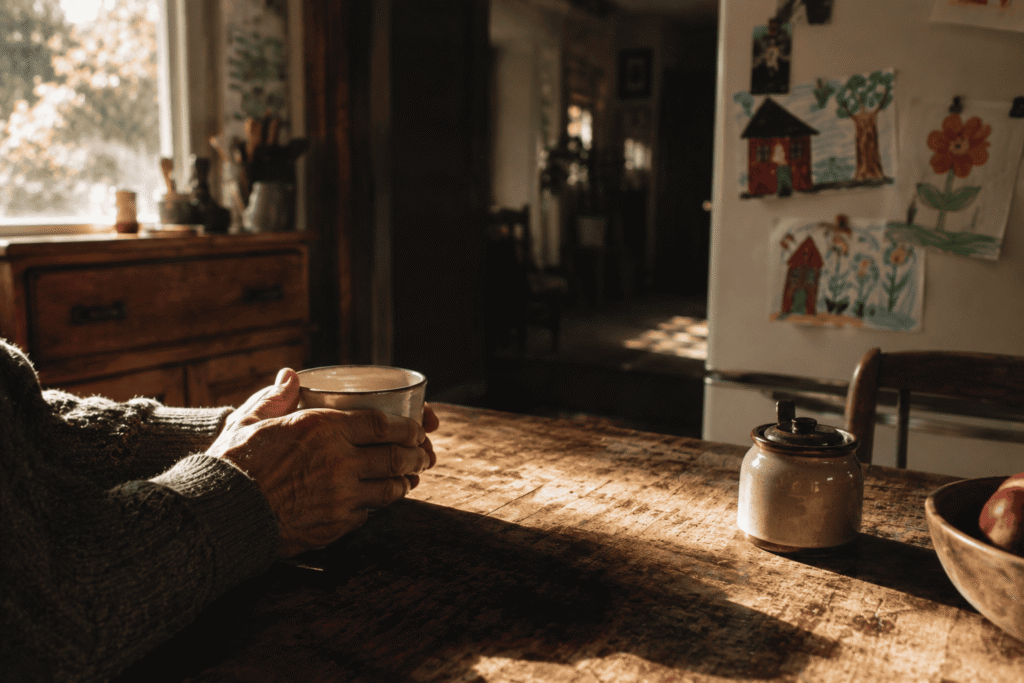
Here is what I’m discovering, and what I suspect many of us are discovering if we’re honest: the targets of meaning shift over a lifetime, but the source doesn’t. A twenty-five-year-old finds meaning in mastery and recognition. A forty-five-year-old finds it in building something that will outlast the moment. A sixty-five-year-old — if they’ve done any real reckoning — finds it in something quieter and harder to articulate. Something that feels less like achievement and more like… contribution. Like being a necessary thread in someone else’s story. Like being loved and loving back, without an agenda.
The target moves. The source stays put. And the source, I’m increasingly convinced, is the experience of authentic love — which is just another way of saying genuine connection with other human beings. The experience of mattering to someone. Of being seen, and choosing to see in return.
Pippin didn’t discover this as a philosophy. He stumbled into it through exhaustion and grace — through running out of spectacular options and finding that what was left was, against all expectation, enough. More than enough.
Proust understood this. He always seemed to understand things several decades before the rest of us caught up. “The real voyage of discovery,” he wrote, “consists not in seeking new landscapes but in having new eyes.”
This is not a comfortable idea. New landscapes are easier. You can book a flight to a new landscape. New eyes require something harder — a willingness to look at the life you already have with a quality of attention you may have been withholding. To see the person across the table, the friend on the phone, the grandchild who wants five more minutes of your time, as the landscape worth discovering.
But Proust had something even more searching to say, and this is the part that I find myself returning to:
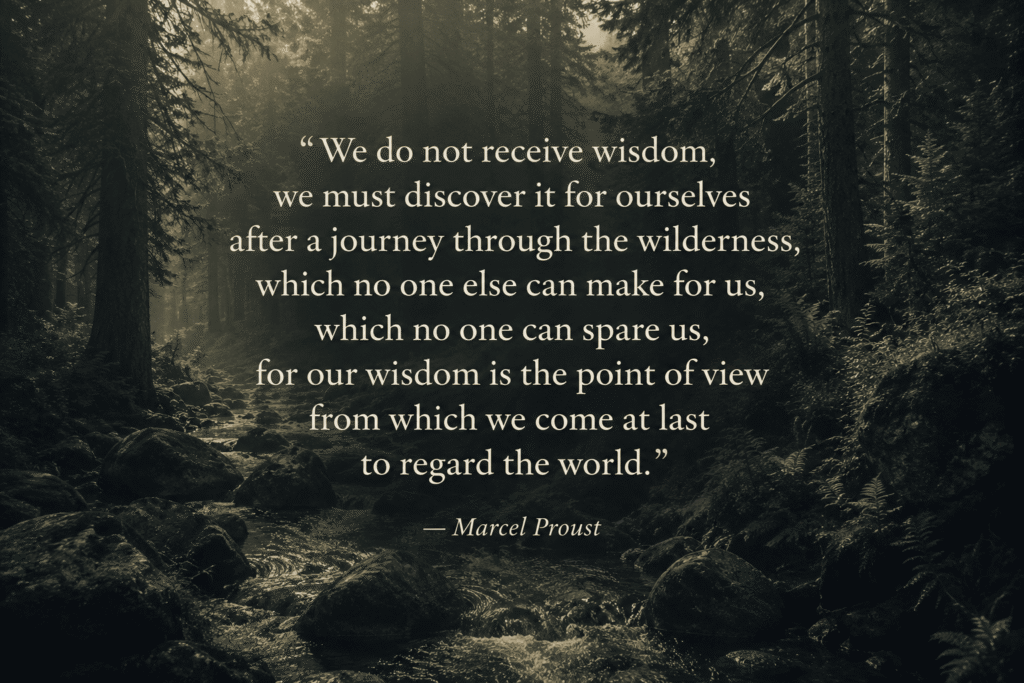
“We do not receive wisdom, we must discover it for ourselves after a journey through the wilderness, which no one else can make for us, which no one can spare us, for our wisdom is the point of view from which we come at last to regard the world.”
Which no one can spare us. I keep landing on that phrase. Because there is a version of the wisdom I’ve been writing about in these pages that can start to sound like a shortcut — as if reading the right newsletter, attending the right retreat, finding the right elder, might save you the journey. It won’t. The wilderness is non-negotiable. Pippin had to try all the wrong things before the right thing could reveal itself. That wasn’t inefficiency. That was the process.
In Signature’s production of Pippin, after all the players have left the stage in the final scene, the son wanders back onto the stage and delivers the reprise chorus (normally delivered by Pippin):
“Rivers belong where they can ramble
Eagles belong where they can fly
I’ve got to be where my spirit can run free
Gotta find my corner of the sky.”
— Pippin music and lyrics by Stephen Schwartz
Having the son sing that reprise rather than Pippin drove home for me this idea that each of us must discover life’s wisdom for ourselves.
What wisdom-holders — elders, guides, mentors — can offer is not the destination in a package you can carry home. It’s something closer to what Proust describes: a point of view. A pair of eyes that have seen more of the landscape than yours have, offered not as a verdict but as a possibility. Here is what I found when I came through the wilderness. You will find something different, but the direction is roughly this.
I’m writing this as someone still very much in the middle of his own discovery. Our Third Act, I’ve come to understand, is not the epilogue where everything finally makes sense. It’s the chapter where the questions get more honest. Where the gap between what we performed and what we actually felt begins to close. Where the meaning we were always seeking starts to look less like a destination we arrive at and more like something we participate in — daily, imperfectly, in the presence of other people who are also, in their own ways, still looking.
Connection. Meaning. Legacy. We began this series thinking about these as aspirations — things our Third Act is supposed to deliver, if we navigate it well enough. I’m starting to wonder if they’re better understood as practices. As verbs, not nouns. As experiences that arise, again and again, in the ordinary moments we used to overlook in our rush toward the spectacular.
Pippin chose the ordinary and found it extraordinary.
Most of us will, too, if we stay long enough to let it reveal itself.
A question for you this week:
Where in your life right now is meaning already present — quietly, without fanfare — that you may be looking past in search of something more impressive?
Shine,

Subscribe to the Newsletter
Join Max J Miller Blog and receive new online content directly in your inbox.
Recommended for Your Journey
Discover more inspiring reads that support your journey toward growth, purpose, and emotional well-being.

[060] When the Writing Discovers Something the Writer Didn’t Know
- Max J Miller

[018] – An Elder Manifesto
- Max J Miller
[006] – Climbing Jacob’s Ladder
- Max J Miller
[036] When I Lost My Beliefs, I Found My Faith
- Max J Miller
[012] – Why I’m grateful for my 20-year detour
- Max J Miller

[068] Somewhere Around the Michigan Border
- Max J Miller