Story #039
When the Teacher Becomes the Student (Again)
Max J Miller
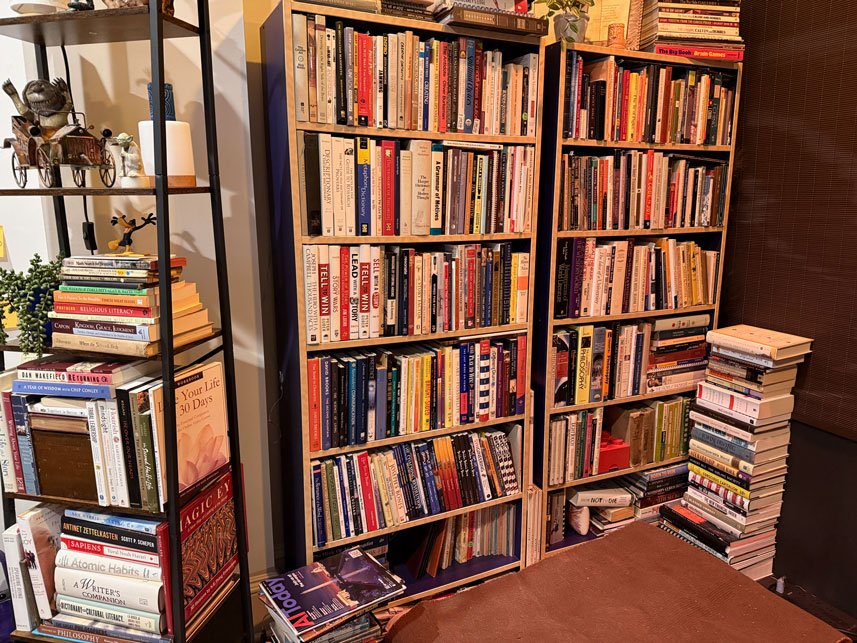
I’m surrounded by books. Here in my home office, twenty-four shelves chock full of books sit within two steps in any direction from my desk.
In two storage spaces within ten feet of my office, more than a dozen boxes are filled with more books. My Kindle also contains over 500 books.
Should I be looking for a 12-step program? Or am I just doing what ambitious people do—preparing for a test that’s already over?
I love to learn, but at times, my reading habit feels more like a compulsion than a simple hobby.
Upon reflection, I recognize that I have internalized a prevailing creed of Western civilization: Knowledge is power.
For forty years, I have lived by that mantra.
And it worked. Every book I devoured, every skill I mastered, every insight I collected added to my arsenal. Knowledge was currency. I traded it for influence, for credibility, for competitive advantage. The more I knew, the more I could do. The more I could do, the more I mattered.
Then I retired. And suddenly, all that power had nowhere to go. Strangely, my habit continued and became more insatiable. At times, it felt Sisyphean, like a library ladder with no top.

I know what this is. It’s compensation. Every unread book feels like a gap in my armor, every conversation where someone mentions a title I haven’t cracked open feels like proof I’m slipping.
I hear someone mention something important they learned from a book, and I instantly search for the title. This pattern has been on my radar for a while now, and lately I’ve been bringing mindfulness to it.
It happened again this week. I learned that Brené Brown has a new book out. I felt the urge to Google the title. I paused to be present to my thoughts and feelings. What I noticed was a compulsive mood, like, “I have to read that book.” It was as if I were experiencing the inverse mantra: lack of knowledge is weakness. And beneath that: You’re falling behind. You’re becoming irrelevant. You’re no longer enough.
I sat with that discomfort for a few days, not trying to fix it, just noticing it. Then today, during a conversation with my friend John about something entirely different, a new mantra began to whisper itself into my awareness… Wisdom is peace.
Not the peace of doing nothing. Not the peace of checking out, opting out, or fading into irrelevance. But the peace that comes from a fundamental shift in stance toward life itself.
Knowledge is always reaching, grasping, and acquiring. It asks: What am I missing? What else do I need to know? How can I leverage this? Knowledge is inherently restless because power requires constant vigilance, constant upgrading, constant proof.
Wisdom, on the other hand, is already home.
Wisdom doesn’t need to prove anything. It observes. It discerns. It waits. Where knowledge accumulates, wisdom integrates. Where knowledge seeks control, wisdom offers perspective. Where knowledge asks, “How can I use this?” wisdom asks, “What does this mean?”
The transition from one to the other isn’t automatic. It doesn’t happen just because you hit a certain age or walk out of your corner office for the last time. It requires something almost heretical in a culture obsessed with productivity: it requires letting go.
Letting go of the need to be the most intelligent person in the room. Letting go of the compulsion to fix everything. Letting go of the identity you built through decades of being the one with answers.
What replaces it? Not emptiness. Not irrelevance. But a different kind of presence.
The elder doesn’t need to dominate the conversation to matter. The wisdom-keeper doesn’t need to solve every problem to contribute. Peace comes from knowing that your value isn’t in your power anymore—it’s in your presence, your perspective, your hard-won ability to see what others can’t yet see.
Knowledge is power was the mantra that built our careers.
Wisdom is peace is the mantra that can complete our lives.
The question isn’t whether we’ll make this transition. Time makes that decision for us. The question is whether we’ll make it consciously, gracefully, on purpose—or whether we’ll spend our third act trying to resurrect a power that no longer serves who we’re becoming.
I’m learning to choose peace. Not because power failed me, but because wisdom is calling me home.
The books are still there—all twenty-four shelves of them. But now I intend to reach for them differently. Not to fill a gap. Not to gain an edge. But to find companions for a journey I’m finally ready to take.
Shine,

Subscribe to the Newsletter
Join Max J Miller Blog and receive new online content directly in your inbox.
Recommended for Your Journey
Discover more inspiring reads that support your journey toward growth, purpose, and emotional well-being.

[084] Beyond the Bucket List: The Calling List
- Max J Miller
[033] Living the Questions: My Spiritual Story Begins
- Max J Miller

[063] The Book in You
- Max J Miller
[083] The Meaning of 83: Why Meaning Happens Between Us
- Max J Miller

[076] Is “soul” too much? (You tell me.)
- Max J Miller

[045] The Most Important Thing Wisdom Keepers Can Do Right Now
- Max J Miller