
Story #035
Standing Outside the Window: When Spiritual Love Turns Hollow
Max J Miller
As I stood among worshipers who were viscerally moved, I suddenly felt as though I was observing it all through a window. It was as if I were outside the ecstatic experience that was sweeping through the congregation. “What am I doing here? Who am I kidding?” I asked myself.
I remembered back to a time when I was fully engaged. “Filled with the Spirit” was the way we spoke of this experience of love and adoration of the divine. Now it felt hollow and lifeless.
In certain love stories, the boy loses the girl emotionally some time before the dramatic breakup occurs. In this stage, that initial lovey-dovey experience of euphoria fades (what psychologists call limerence). The same thing happened in my love affair with God.
In the previous two Wayfinders, I compared my journey of faith to a Rom-Com in its predictable pattern of highs and lows. I offered this graph based on Kurt Vonnegut’s chart of the Boy Meets Girl story shape:

Early in what I refer to as my ‘spiritual awakening,’ I had an ecstatic experience of the divine presence in my life (not unlike the limerence of young love).
That euphoria was integrally bound with the release of guilt and shame I had felt about my queerness. My experience of being unconditionally loved and accepted by God just as I was seemed essential to my spiritual exuberance and my motivation to deepen that divine relationship.
However, when I confronted how vehemently God’s people opposed my newfound sense of wholeness, that spiritual limerence began to fade. Though some in my community attempted to put love before judgment (“love the sinner, but hate the sin”), the notion of a “gay Christian” to them was an oxymoron and anathema to their sense of Christian identity.
In the late 70s, I found no one who validated my experience of God’s acceptance. Even the classics professor who tutored me in reading Koine (Biblical) Greek never gave me outright assurance. However, he encouraged me to search the scriptures for the truth rather than trust in the interpretations and conclusions of others.
Ironically, the more I studied the scriptures, the more doubts I experienced about the claims of Christianity. It wasn’t just doctrines like the virgin birth of Jesus that raised my suspicions. It was primarily the claim of exclusivity regarding salvation. There seemed to be numerous hints that God cared for all humanity. Jesus said, “I have other sheep that are not of this pasture.” He said, “In my father’s house are many mansions.”
More importantly, I found an ever-increasing disconnect between what Jesus emphasized and the matters to which the modern Church seemed to fixate its attention. He stresses the importance of loving and forgiving one another. “They will know you are my disciples by the love you have for one another.” Yet, Christianity fractured into opposing camps about every form of disagreement.
Though disheartened, I didn’t give up searching for the truth. I read a wide range of books by ancient and contemporary Christian authors.
During the 80s and early 90s, a chasm widened between my outer life and inner life.
I continued to participate in a series of Christian communities. Looking back, I sense that I was searching to recapture that euphoria I felt in the early days of my spiritual awakening.
Christians surrounded me. I had moved to Orlando with SAK Theatre to perform at EPCOT. The company was founded by my best friend, Terry, and a group of his friends who met while they were members of a touring Christian theatre troupe. The majority of employees were Christians, and many of us wound up attending the same church, which happened to be housed at the local community theater.
Two themes intertwined through my inner life like streams of oil and water. One theme was increasing intellectual dissonance about Christianity (its belief systems and its divisiveness and hypocrisy). The other, paradoxically, was a growing sense of wonder and fascination with the more mystical insights and wisdom contained in ancient texts, including the Canonical scriptures and others.
With guidance from Joseph Campbell and other teachers, I discovered a treasure trove of wisdom in ancient stories and texts, gaining rich insights into the human condition and the mysteries of life.
I’ve described in previous Wayfinders, for example, how the word “truth” that Jesus used in “The truth will make you free,” has a root meaning of unveiling, or un-concealing. He’s pointing to a profound psychological reality: our attempts to hide aspects of ourselves from others often end up enslaving us. Pulling back the curtain frees us.
However, the dissonance grew between my inner life of doubt, questioning, and skepticism and my outer life as part of a mostly caring and nurturing Christian community. I didn’t have anyone I felt safe to unpack my inner thoughts and feelings with. I had several non-Christian friends, but they seemed to be as immovable in their worldviews as the Christians.
I felt lost in a state of limbo, uncertain. I couldn’t name what I was feeling until I encountered Thoreau’s words…
“The mass of men lead lives of quiet desperation. What is called resignation is confirmed desperation. From the desperate city you go into the desperate country, and have to console yourself with the bravery of minks and muskrats. A stereotyped but unconscious despair is concealed even under what are called the games and amusements of mankind. There is no play in them, for this comes after work. But it is a characteristic of wisdom not to do desperate things.”
— Henry David Thoreau, Civil Disobedience and Other Essays
I was living Thoreau’s quiet desperation. And then something happened that transformed my doubt into something far darker.
Unable to reconcile my sexual identity with the consensus of the Christian community, I suppressed my sexuality for over a decade. I became a celibate monk. In my 20s, this was no easy matter, but I channeled my energies into my career, which flourished.
During that time, a young dancer named Sean befriended me in our shared break room at EPCOT. In our conversations, I sensed Sean was searching for meaning in his life. I invited him to church and gave him one of my study bibles. He got very active in church and seemed to be thriving.
One Sunday, our pastor somberly announced that Sean had taken his own life. I was stunned and heartbroken, and tried to make sense of what happened. I heard from other members of his Bible study group that he had continued to struggle with sexual temptations and feared that he might never “live up to God’s standards.”
I saw myself in Sean. A decade before I had come so close to ending my own life.
It grieved me deeply that I had a part in leading this gentle, graceful young man into this dark and hopeless path from which he saw no escape. I had internalized my community’s homophobia, and now I feared I had passed it on tragically to another dear soul.
My grief for Sean mingled with my grief for the young Max who had encountered a God who loved him just as he was: a vibrant, creative, loving, gay young man.
It would take another decade before I would find my way back to self-love.
My journey back to any sense of authentic spiritual life took considerably longer. Metaphorically, I liken it to Moses’s forty years in the wilderness.
I could also liken it to the opening scene of Dante’s Inferno:
“Midway along the journey of our life
I woke to find myself in a dark wood,
for I had wandered off from the straight path.”
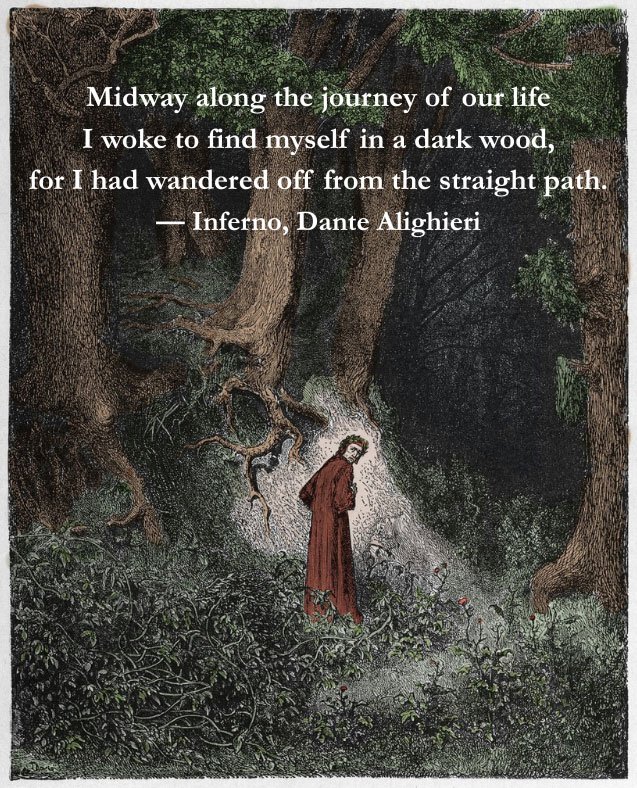
I had indeed wandered from the path I’d been given. But as I would slowly, painfully discover, sometimes you have to lose the wrong path to find the right one.
The wilderness doesn’t care about your timeline. It takes as long as it takes.
Next week: The Long Road Home
Shine,

Subscribe to the Newsletter
Join Max J Miller Blog and receive new online content directly in your inbox.
Recommended for Your Journey
Discover more inspiring reads that support your journey toward growth, purpose, and emotional well-being.

[050] The Return: From Finding Your Voice to Using It
- Max J Miller

[013] – Men, Loneliness, and the Power We’re Not UsingWe’re Not Using
- Max J Miller

[002] – The Surprising Seed of Wisdom
- Max J Miller
[069] The Difference Between Following Rules and Becoming Someone
- Max J Miller

[058] What Mystics Across All Traditions See About Unity (And Why It Matters for Wisdom Keepers)
- Max J Miller

[009] – Redemption in a Story
- Max J Miller