
Story #003
Question Everything

Max J Miller

Question Everything
One of my earliest memories of being “labeled” was by my third-grade teacher. She gave my mother a report card, which Mom shared with me.
We went over my scores (they were numbers, not A-F grades) in performance areas such as “Maintains Focus During Class.” (That was a 4, which meant ‘below average.’)
The card also had some handwritten words about my personality and behavior. I spotted the word ‘inquisitive.’ Of course, I asked, “What does that mean?”
“It’s what I tell you all the time,” Mom said. “You ask a lot of questions.”

“Is that a good thing?” I asked
“It can be,” she replied. “It’s good to be curious.”
I sensed the unspoken ‘but’ in the way she emphasized “can.”
“So, when is it a bad thing?”
“You have to be sensitive to people who don’t want to answer all sorts of questions.” She paused and took a breath. “Then it can seem a bit annoying.”
Somehow, my curiosity triumphed over my fear of being a pest (or disliked). I kept asking questions. Sometimes, I sensed annoyance, and sometimes, it was worse.
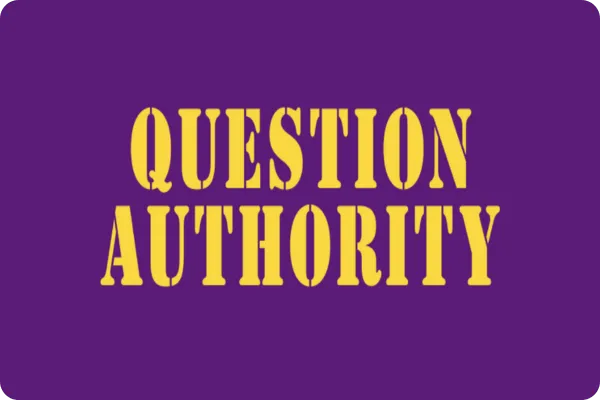
Entering my teens in the tumultuous era of the late 60s, I saw a protest sign that declared, “Question Authority!” I recreated it in my garage and carried it during a walk-out that my 8th-grade classmates and I organized to protest the Vietnam War.
The Vice Principal hauled me into his office, shouting, “I want some answers from you, young man.”
I showed him my sign and said, “I don’t know if I have answers for you, but I have some questions.” I secretly delighted in watching steam escape his ears.
At other times, teachers and authorities encouraged my curiosity.
One Sunday, my evangelical pastor delivered an impassioned stewardship sermon. His reference verse was Matthew 6:21, “For where your treasure is, there will your heart be, also.” His sermon emphasized that using money is a beacon of your affections (if you love God, you give to God’s work).
I approached him and asked, “Pastor Olson, couldn’t that verse also imply that what you invest in will become increasingly important to you? (Your heart follows your investments.) So, we should be careful about what we invest in.”
To my surprise, he smiled and replied, “That is a perfectly valid interpretation of what Jesus was saying…and it would lead to a completely different sermon.”
My curiosity and boldness to ask questions became my superpower at an early age, and over time, it emerged as a central feature of my identity. When email began, my first email addresses were ‘curious@earthlink’ and ‘curious@aol’ (I was naive to the slang use of the term, curious.)
Though my questioning eventually led me away from my Evangelical identity, I still take inspiration from the way Jesus interrogated the authorities and the flock. He’s an extraordinary model of spreading wisdom through insightful questions.
My biggest takeaway from studying the Christian Bible is seeking the question behind the question. Often, Jesus seems to say to those who question him, “You’re asking the wrong questions.”
So many questions that people asked Jesus suggest that they were desperately trying to get it right—to prove themselves acceptable. His questions seemed to redirect their curiosity and attention to what truly matters—things like love, kindness, and forgiveness.
I want to learn to ask those sorts of questions.

A Call to Those Who Will Not Die With Their Wisdom Still Inside Them
I’m learning that to experience freedom and peace of mind, my mind (thoughts and emotions) must become a subject of my questioning. Our minds are full of mischief, and while they exist to help us survive, they don’t always encourage our highest aspirations.
It helps to ask questions of my mind at arm’s length. Instead of asking, “Why am I feeling this way?” I ask, “What is prompting this thought or emotion?”
This approach affirms that I am not my thoughts (nor am I my emotions). I’m not even the source of them. I am the space of consciousness in which they appear.
More on that another time.
One of my favorite poets, W. H. Auden, wrote a poem in which he speaks directly to his “precious five” senses and implores them to be happy. The poem shows that we can distinguish even our senses from our being, and find freedom (and happiness).
Precious Five
– W. H. Auden, 1950 (Originally published in Harper’s)
Be happy, precious five,
So long as I’m alive
Nor try to ask me what
You should be happy for;
Think, if it helps, of love
Or alcohol or gold,
But do as you are told.
I could (which you cannot)
Find reasons fast enough
To face the sky and roar
In anger and despair
At what is going on,
Demanding that it name
Whoever is to blame:
The sky would only wait
Till all my breath was gone
And then reiterate
As if I wasn’t there
That singular command
I do not understand,
Bless what there is for being,
Which has to be obeyed, for
What else am I made for,
Agreeing or disagreeing?
I hope you will “bless what there is for being” even in moments of anger and despair (and other unsettling thoughts and emotions).
Cheers,

P.S. Do me a huge favor and forward The Wisdom Wayfinder to friends who may enjoy it.
Subscribe to the Newsletter
Join Max J Miller Blog and receive new online content directly in your inbox.
Recommended for Your Journey
Discover more inspiring reads that support your journey toward growth, purpose, and emotional well-being.

[044] The Finish-Line Fallacy
- Max J Miller
[025] Agency: The Art of Acting with Courage in Our Third Act
- Max J Miller

[055] The Good: When the Meaning Changes, Everything Changes
- Max J Miller

[079] Doubt as My Climbing Companion
- Max J Miller

[018] – An Elder Manifesto
- Max J Miller

[013] – Men, Loneliness, and the Power We’re Not UsingWe’re Not Using
- Max J Miller