
Story #012
Why I'm grateful for my 20-year detour

Max J Miller

Calling All Sages
Thank you for your feedback on my draft of the purpose statement for The Wisdom Wayfinder. I won’t repeat it here, but you can find it at the end of last week’s edition [011].
With your feedback and some reflection, I distilled it down to one phrase:
“Cultivate a Community of Storytelling Sages to Infuse the World with Wisdom.”
You may or may not see yourself as a sage, but try it on as the aspirational “calling” of your third act.
I see our ‘third act’ through Joseph Campbell’s hero’s journey lens:
1. Act One represents the beginning of life, where we leave the safety of our “home” (childhood) and step into the world to discover who we are and what we’re capable of.
2. Act Two represents the prime of life, filled with challenges, accomplishments, heartbreaks, and triumphs.
3. Act Three contains our final decades, which mirror the hero’s return: we rejoin our community, changed by what we’ve learned, ready to share the “boon” we’ve discovered with others.
If the Wisdom Wayfinder purpose statement speaks to you in any way, please let me know.
This week’s In Search Of…My Wisdom Legacy story continues where my “Mulholland Drive story from last week [011] left off. It demonstrates the “redemption” principle I address in this week’s Ideas Worth Shredding.
Thank you for continuing with me on this journey.

Midlife Chrysalis
Looking back at my infamous “Mulholland moment” (check out Edition [011]), I now see all the signs of a midlife crisis—even though I was in my late thirties at the time.
My choices seemed limited. I could stick it out in a prestigious career that, while impressive, left me feeling unfulfilled. Or, I could leap into something more meaningful, risking stability and lifestyle in the process.
I stayed put for a few more years, taking classes, reading voraciously, and seeking advice from friends and counselors. My career carried me through other themed entertainment companies, but I realized the problem wasn’t with the industry. It was with me. I needed to understand myself and what truly satisfies me.
Facing the Leap
I toyed with entrepreneurial ideas. (After all, both my father and stepdad were entrepreneurs.) But each time, I felt that familiar fork-in-the-road anxiety. Do I stick with what I know or leap into the unknown?
Looking back, I see that I was afraid of “taking the reins” of my life. My career up to that point felt like it was running on autopilot. Last week, I described my career path as falling into a river and getting carried away by the current. It may be more accurate to say I encountered a series of open doors and stepped through them.
Now, the idea of charting my course and knocking on doors seemed daunting. Do I have the stuff to make it on my own?
In my mind, I heard The Clash’s “Should I Stay or Should I Go Now?” mixed with Van Halen’s “Jump” and Fleetwood Mac’s “Go Your Own Way.” My spirit was begging for a leap of faith, but I hesitated.
Then 9/11 happened.
Everything stopped. The themed entertainment industry came to a screeching halt. I had no choice but to pivot.
In the first few years after 9/11, I launched a few small businesses, juggled various jobs, and kept searching for my purpose. I’ve described this period in Issue [009] “The Edison of Entrepreneurship: A Legacy in Beautiful Failures.”
For a few years, I attempted to parlay my Disney credentials as a corporate “creativity consultant.” It was exciting for a while, and something about it felt more authentic, but I still sensed I wasn’t quite dialed into my true purpose.
Further Along The Long and Winding Road
One day, I’m with my therapist, and he asks me how long I’ve kept a journal.
“Since I was a freshman in college,” I told him.
“Do you ever go back and read what you wrote years ago?” he asked.
“Rarely. Occasionally, I use them to remember when and where events happened,” I said. “They’re a sort of timeline of my life.”
“I’d like you to go back and read the first few journals to see if you can find any clues about your purpose,” he suggested. “Look for anything that looks like a dream or yearning of any kind.”
I wasn’t very hopeful about this approach because my journals were not diaries. I didn’t write down my feelings and secret thoughts. My journals were a tool to capture ideas. I took notes from classes, meetings, and lectures. I kept notes from books and articles I read.
Nevertheless, I started reading my first journal. My handwriting was awful. My mother used to apologize to my teachers for my handwriting, saying, “He’s named after his grandfather, who was a doctor, and he inherited his handwriting as well.”
About halfway through the first journal, I came across notes from a Bible study group I had attended. The topic was “spiritual gifts,” and our discussion centered around discerning our vocations.
Transported Back in Time
These notes scrawled in my journal were like a portal transporting me back through time. I remembered that discussion and how it focused on each individual in succession. The group would share impressions of that person’s gifts and speculate about their “calling” (vocation).
When it came around to me, the consensus was that I should be a pastor or a teacher. I flat-out rejected the idea of becoming a pastor. Then our group leader weighed in. “What about teaching the pastors, like in a seminary or university?” he asked.
The notes in my journal became more energetic at this point. My handwriting grew larger and bolder.
A wave of emotion washed over me as I remembered how inspired I was at the thought of teaching pastors. I felt a bit of that early excitement, but it was mixed with other feelings. Sadness? Regret?
On my next visit to my therapist, I brought the journal and told him of my experience. As we discussed the implications of this revelation on my sense of purpose in life, I became very curious about one issue: what had happened to that once-vivid sense of calling or destiny?

Buried Treasure
Throughout my entertainment career and for several years afterward, I never had a thought about becoming a teacher. All my soul searching for purpose never stirred memories of this hopeful chapter. Why was that?
As I unpacked this with my therapist, it became apparent that I hadn’t merely forgotten this sense of calling from my college years. I buried it.
Had my journal been a diary, it would have recorded the emotional turmoil I experienced around coming to terms with being gay inside an evangelical community that condemned that “lifestyle choice” as sin.
Though I eventually came to terms with my sexuality, teaching in a seminary would have meant remaining closeted. In my struggle to work through all of this, I buried my sexuality for a few years and with it, my vision of teaching future leaders.
My entertainment career unexpectedly launched during that time, and it continued for over two decades. I described my career trajectory to my therapist as if I had “fallen into a river and gotten carried away by the current.” The truth? I jumped into that river to escape the hopelessness I felt.
Redemption
I found one more clue in my journal about my calling. Jim Rohn, the man who gave me my first journal and inspired me to keep a journal throughout my life, led a weekend workshop in Minneapolis while I was in college.
When I walked into the workshop room, I was surprised to see that it was set up for thirty people. I had previously seen Jim Rohn speaking to a crowd of hundreds of people.
I sat in the front row. When he came into the room, Mr. Rohn introduced himself to a few individuals. When he reached the front of the room, he greeted me and asked for my age. I was 19, but I could have passed for 12.
About half the time, Mr. Rohn sat on my desk while he spoke. Several times he referenced me and my age, like, “Imagine learning these things at 19. What difference might that have made in your life?”
It felt like I was having a one-on-one conversation.
At one point, I asked him, “How did you develop all your material?”
He looked me in the eye and said, “You live your life, pay attention, and record what you learn in your journal. Before you know it, you’ll have ideas and stories to share.”
He was absolutely spot on.
Here’s the thing about looking back on your life story: It’s your story.
Back then, things didn’t add up. It all felt senseless and wrong.
Now, looking back over my life, I’m so grateful. What seemed like wandering in the wilderness turned out to equip me with skills, contacts, and experiences ideally suited for my purpose.
And mysteriously, the aspects of that call that inspired me in college are all present in this version as well: I’m teaching, I’m inspiring leaders, I’m calling people to follow their calling.
Just like in the third act of a play, all the loose ends start to weave together, and the characters’ deepest longings find their surprising fulfillment.
Today, I celebrate that my detours were not mistakes. They were preparing. Every wandering step was leading me home to who I was meant to be. I also celebrate that a buried calling doesn’t die; it transforms into something more beautiful than I could have imagined.

Sorry Mom, But You CAN Change the Past
My mother used to blend old expressions like a linguistic smoothie. “Oh, for crying out loud” and “Stop crying in your beer” became “Oh, for crying in your beer!” And then there was my favorite, “Don’t throw the baby Jesus out with the baptism water.” Wait, what?!
One saying, however, she repeated often and accurately: “You can’t change the past.”
I love you, Mom (RIP), but that’s one idea I can’t abide.
The past doesn’t exist in the material universe; the “past” that we relate to dwells entirely in our minds.
Sure, the facts don’t change—I still did that cringeworthy thing in 1987. But facts without context are just trivia. What is the meaning, the emotional weight, the significance? That’s all negotiable. That means that the past that matters is a matter of mind over matter. If you don’t mind, it doesn’t matter.
As Woody Allen put it, “Comedy is tragedy plus time.” What once seemed like the end of the world later becomes an amusing anecdote.
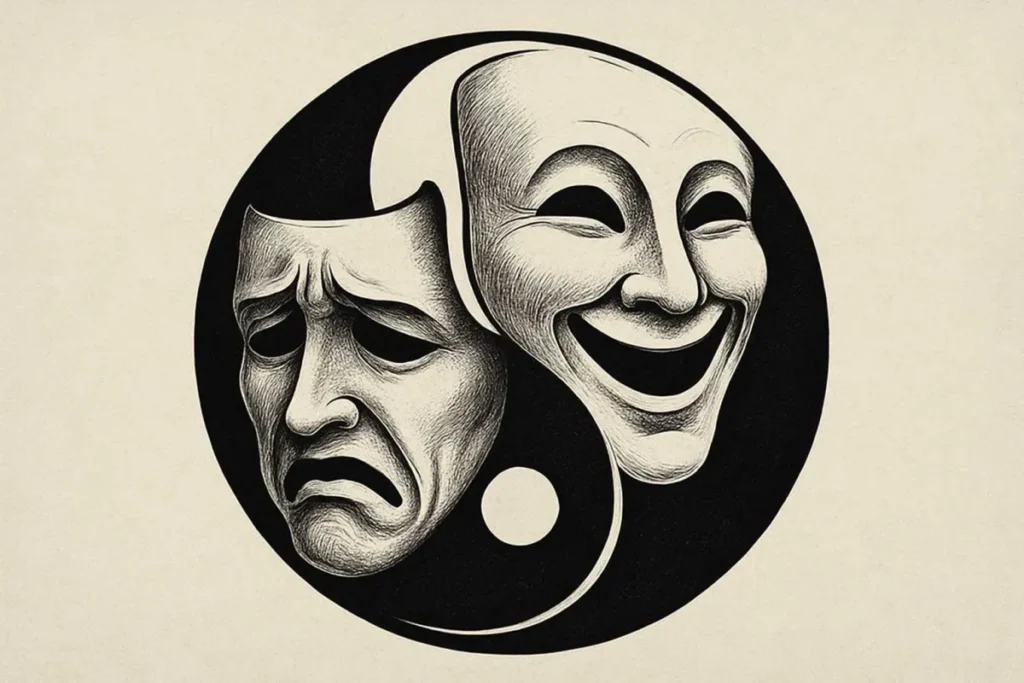
Changing your past story changes your future behavior: When I reframe my failures as opportunities for learning, I become braver. When I see my embarrassments as material, I become funnier. Same past, different person.
Nearly any experience in our past can be reframed in the present as a story that redeems the struggle of our earlier self. I’ve been reframing past experiences in every edition of The Wisdom Wayfinder. Every story says, “That experience makes me who I am today.”
And the story we tell reveals if we like the person we have become or not. I like the person I have become, and I freely tell stories about my life that would make my younger self cringe.
From the Tao Te Ching, I’ve discovered that my younger self, like my current self, is mostly illusion. “When we see through our conditioned mind, we find our true nature waiting.” (Chapter 19)
My therapist charges $150 an hour to help me change my past. I call it ‘premium historical revision services.’
If the past that exists in our minds is fraught with misunderstanding, and if we continue to grow and let go of those illusions, the past continues to transform in us.
Can’t change the past? There’s an idea worth shredding!
Cheers,

P.S. Got thoughts about the Elder Manifesto? Join our Town Hall. Reply to this email to receive an invitation to the event.
Subscribe to the Newsletter
Join Max J Miller Blog and receive new online content directly in your inbox.
Recommended for Your Journey
Discover more inspiring reads that support your journey toward growth, purpose, and emotional well-being.
[017] – Escaping the Self-Help Trap
- Max J Miller
[082] 17 sparks of wonder from Nashville
- Max J Miller
[042] You Can’t Make Him Drink: What a Scout Camp Taught Me About Teaching Anyone Anything
- Max J Miller

[055] The Good: When the Meaning Changes, Everything Changes
- Max J Miller
[023] Awareness: The Hidden Portal to Thriving in Your Third Act
- Max J Miller

[079] Doubt as My Climbing Companion
- Max J Miller