Story #013
Men, Loneliness, and the Power We’re Not UsingWe’re Not Using
Max J Miller

What distinguishes the person who thrives in their third act?
That’s the question I set out to answer over the last two years. In addition to other forms of research, I conducted interviews with over thirty individuals of retirement age.
I’m using the term ‘thriving’ as opposed to ‘happiness’ or ‘health’ to encompass a broader sense of vitality, well-being, engagement, and satisfaction or fulfillment in life.
In the next section, I will share the conundrum that I discovered in my research.
Then in Ideas Worth Shredding, I’m taking a stab at a sacred cow of some folks, “Time Heals All Wounds.”
Thanks for joining me on this journey.

Loneliness, Legacy, and the Wisdom We’re Meant to Share
The most surprising discovery I made is that thriving does not appear to be highly correlated with material wealth or excellent health.
The single factor I found common among thriving individuals is happy, meaningful relationships. These include spousal relationships, family, and significant friendships.
Though I didn’t follow a scientifically rigorous process, my conclusions seem to be consistent with academic research on the subject. Dr. Robert Waldinger, who heads the Harvard Study of Adult Development, found that quality relationships are the most significant determinant of healthy aging. He says, “Good relationships don’t just protect our bodies; they protect our brains.”
In his book, Aging Well, George Vaillant concludes that satisfaction with relationships is the most significant factor predicting healthy aging. However, Vaillant points out that this does not bode well for a vast swath of our aging population who do not have strong, satisfying relationships. Like other social scientists, Vaillant points to a growing “epidemic of loneliness.”
My informal research provided me with some insight into this darker aspect of the thriving-relationship phenomenon.
The scientific research suggests that this epidemic of loneliness is predominantly affecting retired men. That makes intuitive sense. Forgive me for using this stereotype, but women are generally more adept at developing meaningful relationships than men. I’ve no idea how much of that is innate and how much is culturally imbued.
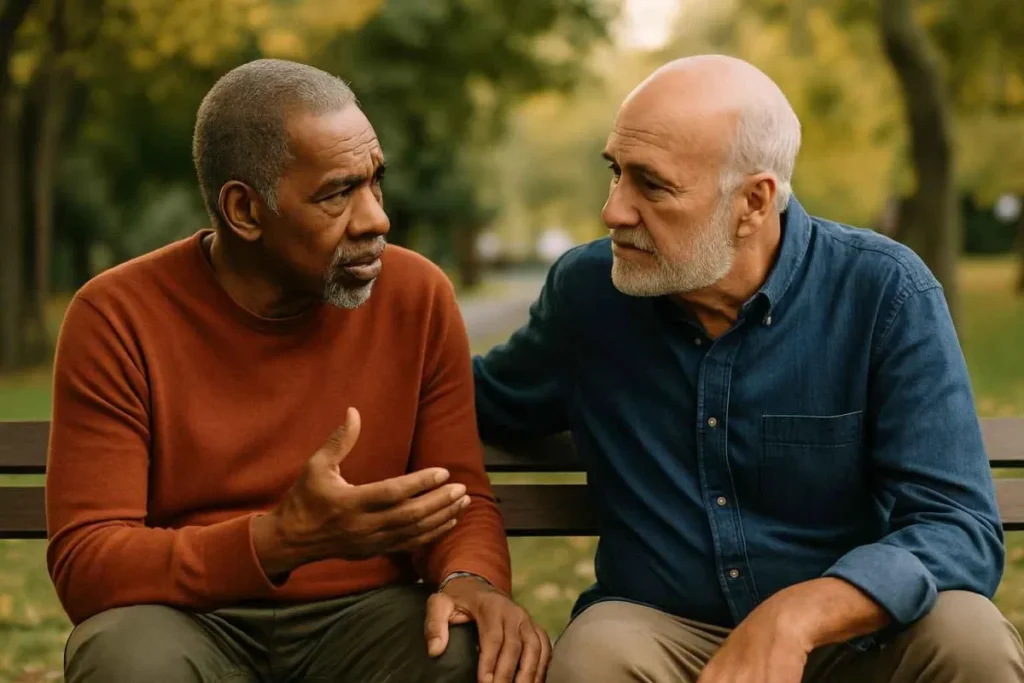
The conundrum of resolving this loneliness epidemic comes down to two factors. First, men don’t generally recognize the true nature of the problem of loneliness. Second, they are often resistant to exploring potential solutions to the problem.
A few of the women I interviewed expressed concern regarding their husbands’ isolation and lack of meaningful friendships. When I asked if their husbands would consider themselves “lonely,” the women universally answered, “No.” They said their husbands complained of boredom and dissatisfaction with their social relationships.
One man I interviewed acknowledged that loneliness was his greatest fear since retiring. He missed his daily interaction with colleagues. More significantly, his best friend since grammar school passed away unexpectedly, and he feared he could never develop a close friendship like that again.
Women see the solution clearly: go make some new friends. Men don’t see that as an opening for action. Men often view friendships as a byproduct of working together in a job, a sport, or another task-oriented activity.
Several women told me their husbands were reluctant to join any new group activities or initiate any form of connection. Unfortunately, most of the literature on this loneliness epidemic offers little guidance for a remedy beyond “Find a group to join” or “Volunteer for a youth program or soup kitchen.”
I’ve seen men build deeper relationships in a variety of small-group contexts, including 12-Step programs, church book studies, and therapy groups. These groups center around one activity that is essential to building deep relationships: sharing personal experiences.
The same thing happens each time I lead a storytelling group. People bond over sharing the meaningful stories of their life struggles and triumphs.

What if there were hundreds (or even thousands) of groups gathering weekly, connecting authentically, and documenting their meaningful stories for future generations? Could we make a dent in the loneliness epidemic? Could we empower seniors to be sages and raise the level of wisdom in our culture?
The question I keep asking is this: how do I “package” this opportunity in the most enticing way to people who may be hesitant to join a group, though it may be a key to helping them thrive?
I’ve learned the better question to ask is “Who?”, not “How?”
So, who might you recommend to advance this vision? As always, hit ‘reply,’ and share your thoughts and suggestions.

Healing Isn’t a Clock–It’s a Connection
“Time heals all wounds?”

Ah, “time heals all wounds”—the Hallmark card of emotional wisdom. You’ll often hear it offered with a shrug, a sympathetic pat, or worse, as a polite way to exit someone else’s pain.
It sounds comforting. It’s just not true.
Time may scab over a wound. It might let you forget it for a while. But real healing? That takes attention. That takes care. That takes people.
A broken heart doesn’t magically stitch itself back together just because the calendar flipped. Betrayal doesn’t dissolve after 18 months and 3 birthdays. Grief doesn’t gently fade away while you reorganize your sock drawer.
Healing is not passive. It’s relational.
It happens when we speak the unspeakable—and someone stays to listen.
It happens when someone says, “I see you. And I still love you.”
It happens when empathy shows up in the form of a friend, a therapist, a letter, or a shared silence.
Time is just the stage. It’s what happens on the stage that counts.
Without conversation, without reflection, without a witness to our wounds, time alone often just buries them deeper.
So next time someone’s hurting, skip the clichés. Don’t offer time. Offer presence. Offer curiosity. Offer space for the story to be told. That’s where healing begins.
“Time heals all wounds?”
That’s an idea worth shredding.
Cheers,

P.S. I’m building a team to grow communities of storytelling sages. Intrigued? Hit reply, and I’ll invite you to a Town Hall on the topic.
P.P.S. Got an Idea Worth Shredding? Submit it here.
Subscribe to the Newsletter
Join Max J Miller Blog and receive new online content directly in your inbox.
Recommended for Your Journey
Discover more inspiring reads that support your journey toward growth, purpose, and emotional well-being.
[048] Subtract to Find Your True Voice
- Max J Miller
[003] – Question Everything
- Max J Miller
[069] The Difference Between Following Rules and Becoming Someone
- Max J Miller

[037] Did I throw the baby Jesus out with the baptism water?
- Max J Miller
[032] Ascend: Rising Above the Ugliness of Our Cultural Divide
- Max J Miller

[044] The Finish-Line Fallacy
- Max J Miller