Story #017
Escaping the Self-Help Trap
Max J Miller

Meaning Redo
The curtain rises on the third (and final) act. The varied threads of the story are about to converge, weaving together moments of triumph, conflict, and transformation. This is where the play’s meaning is revealed, where the playwright leaves the audience with insights to carry home.
However, this is our third act in which we are both the players and the playwrights. In our third act, we return, as in the hero’s journey. We reflect upon what has happened and even reinterpret the story’s meaning thus far. We have the opportunity to redeem and even reinvent ourselves.
In the last couple of Wisdom Wayfinders, I’ve suggested that we reclaim the authorship of our story, but one reader asked, “How do we rewrite what’s past?”
This week’s story explores what we can and cannot change.

Beyond Getting Better: A Curbside Revelation
In the decade after I left Walt Disney Imagineering, I was drifting. From the outside, it might’ve looked like I was exploring. On the inside, I was grasping. I read mountains of books, took courses and workshops on every shape and stripe, and searched for the next thing. The thing that would help me “get better.”
One of those weekends, I was at a seminar in the Bay Area called The Wisdom Course. It was part of a year-long program, and by then, I was several months in, still hopeful and still hunting.
Just before the lunch break, a woman beside me raised her hand. Her voice cracked slightly as she said, “I’ve done so many of these courses. And I still don’t feel like I’ve gotten any better.”
The room went quiet.
Standing near the whiteboard, the instructor walked deliberately in front of her. Then, scanning the room slowly, he said, “This is for all of you. You want to listen like your life depends on it.” He shifted his gaze sharply from one person to another, then turned, looked straight at me, and added, “This is for you.”
I froze.
Then he said, “None of the courses we offer are designed to make you better. This work is not, in any way, about self-improvement. You can take courses all your life, but you’ll never be a better version of you.”
The woman burst into tears. He handed her a tissue and gave her a moment to compose herself. I don’t remember what he said next because my mind was spinning. I was feeling confused and even defensive. I was that woman. I had been investing time, energy, and a not-insignificant amount of money to improve myself. If not that… then what was I doing?
Then he gave us a new assignment for lunch. “Instead of the planned exercise, here’s your inquiry: What are these courses really about? And why are you participating if they’ll never make you better?”
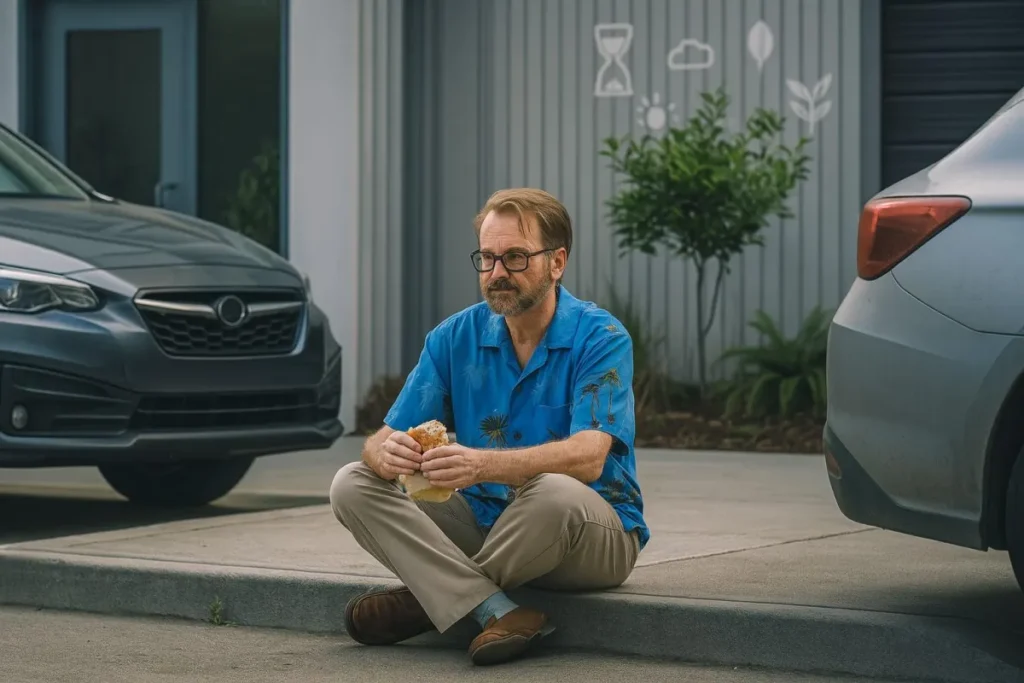
I took my sandwich outside. The seminar was being held in a nondescript building in an industrial park. Finding no grassy lawn or benches nearby, I sat on the curb between two parked cars. I opened my sandwich on my lap and contemplated the question clanging like a bell I couldn’t unhear.This idea has been sold for generations. And it’s deeply flawed.
Intellectually, I knew these programs were not about “fixing” us or even “self-improvement” per se. “Transformation,” as this work was called, is “about what our lives can be when they cease to be about getting better.” I’d repeated that assertion innumerable times.
Still, at that moment, it was painfully apparent that I secretly believed something in me needed fixing. I had participated in transformational programs with a hidden agenda to finally get better. So, I stopped and asked the question again:
Why am I doing this?
Had I been wasting my time?
I felt a quiet current of panic. I considered bailing on the course altogether.
I remembered something I’d heard years before from one of my mentors, Jim Rohn. He used to say, “For things to get better, you have to get better.” That always made sense to me.
But now that I was really listening, I realized that wasn’t exactly what he said. His actual quote was:
“For things to change, you have to change.”
– Jim Rohn
Isn’t that the same thing? I wondered. What’s the difference between getting better and changing?
I kept circling back to the instructor’s question. It wouldn’t let me go.
I felt a wave of emotion arise from deep within. Impulsively, I tried to dismiss these feelings. They persisted, and I chose instead to pay attention to them.
What am I feeling? I feel sadness, regret, and a strange sense of loss.
Taking a deep breath, I sensed my mind quiet down.
I asked the question again, but it wasn’t an assignment this time. I truly wanted to discover the truth for myself. What am I doing here? Why am I participating if these courses won’t make me better?
I took another deep breath. One word arose in my mind: possibility.
I hear that word all the time, but I wasn’t even sure I knew what it meant anymore.
Possibility? What is that?
The word itself felt… unstable.
I asked the question again, “Why am I taking this class?”
This time, the response was clearer: to expand what is possible.
That was it.
I wasn’t here to improve myself. I was here to expand what is possible.
Expand what is possible for me to experience.
Expand what’s possible to do.
What’s possible to be.
And none of that requires “getting better.”
It was a radical thought. But it rang true.
Still, I was left with the riddle of Jim Rohn’s quote. “For things to change, you have to change.”
Maybe what he meant was simpler than I’d always assumed.
Maybe he wasn’t urging me to change who I am, but to change my point of view.
And as soon as I saw that, I chuckled. I remembered something George Carlin once said: “You can’t have everything—where would you put it?” Then he followed up with, “Actually, you can have everything… if you just leave it all right where you found it.”
That’s the power of a shifted point of view.
I thought back to an idea I’d heard at the very start of this journey:
You may think of yourself as broken or incomplete. But try on a new perspective: that you are whole and complete right now. What about the thoughts and feelings that seem like evidence to the contrary? They’re just that: thoughts and feelings. Just remember, you are not your thoughts and you are not your feelings.
— Wisdom Course leader
The first time I heard that, it sounded like something from another planet. But now, sitting on a curb in a parking lot, I felt like I was starting to see it.
I’m no longer in the business of getting better.
I’m in the business of expanding what’s possible.
That shift changes everything.
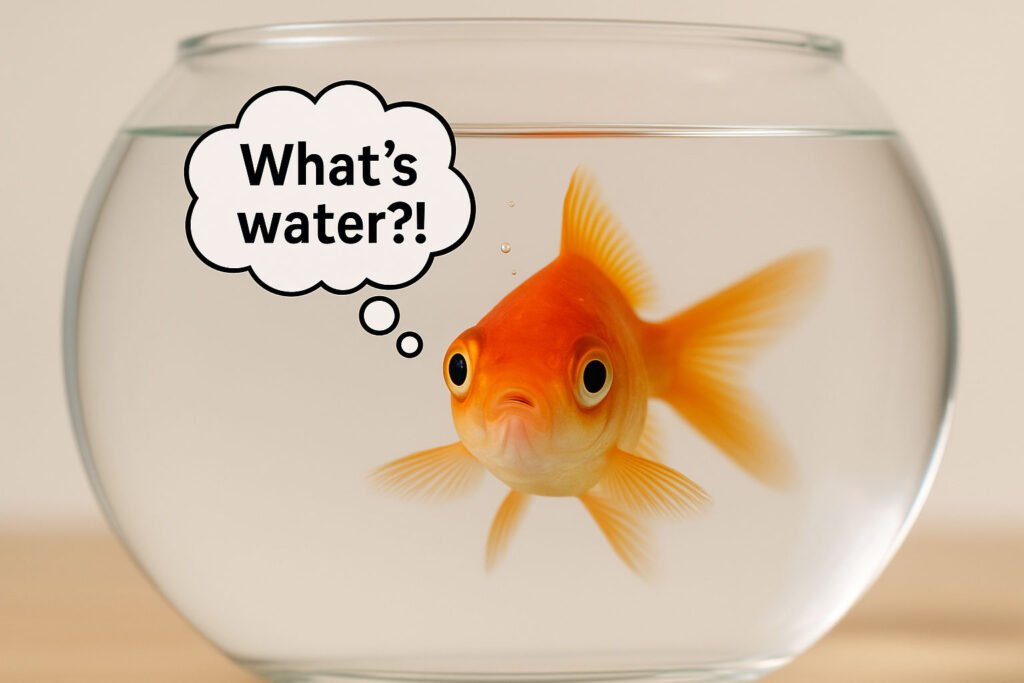
It means letting go of the thoughts and feelings that obscure my vision. But those thoughts and feelings are sneaky. They’re like the water to a fish—so constant and familiar, we forget they’re there. If you asked a fish, “How’s the water?” it might just blink and ask, “What’s water?”
Meditation can help us start to notice our water. But the fastest way I’ve found to spot those hidden limitations is this:
Commit to something that lives outside your comfort zone.
Because when you stretch toward something bigger than your familiar self, you’ll bump into your invisible walls.
And when you do?
That’s where the real work begins.
Not to fix yourself.
But to free yourself.
To see farther.
To expand what’s possible.
That’s the legacy I’m seeking now.
Shine,

P.S. We’re in the process of migrating “Ideas Worth Shredding” to YouTube. In future editions we’ll add a link so you can watch them..
P.P.S. As always, I love hearing from you. Hit ‘reply’ and send me your thoughts.
Subscribe to the Newsletter
Join Max J Miller Blog and receive new online content directly in your inbox.
Recommended for Your Journey
Discover more inspiring reads that support your journey toward growth, purpose, and emotional well-being.
[008] – Charlie Hustle, Street Theater, and the Soul of Story
- Max J Miller
[059] Hangry in Devon: How My Friends Caught Me When I Broke Unity
- Max J Miller

[051] The First Gift of the Wisdom Keeper: Listening to Your Life
- Max J Miller
[010] – What Am I Doing Here?
- Max J Miller

[084] Beyond the Bucket List: The Calling List
- Max J Miller
[001] – Is There LIFE Beyond…Your Bucket List?
- Max J Miller