
Story #079
Doubt as My Climbing Companion
Max J Miller

No sooner had I declared my new role as “Investigator of Wisdom” and “Imagineer of Meaning” in this nascent eldership movement (see issue #77) than waves of uneasiness, even anxiety, washed over me.
I reached out to my regular sparring buddies and quickly named what I was feeling: doubt. That old theatre mantra still serves me well: “When in doubt, stick your hand out.”
Through those conversations, and through journaling and reflection, I began to sort my doubts into two clusters.
The first centered on the elder project itself:
Is there sufficient interest to create a movement around this?
Does anyone care about this the way I do?
The second was simply self-doubt:
Who am I to instigate such a project?
Will my age and health hamper my capacity to see it through?
From the Department of Synchronicity
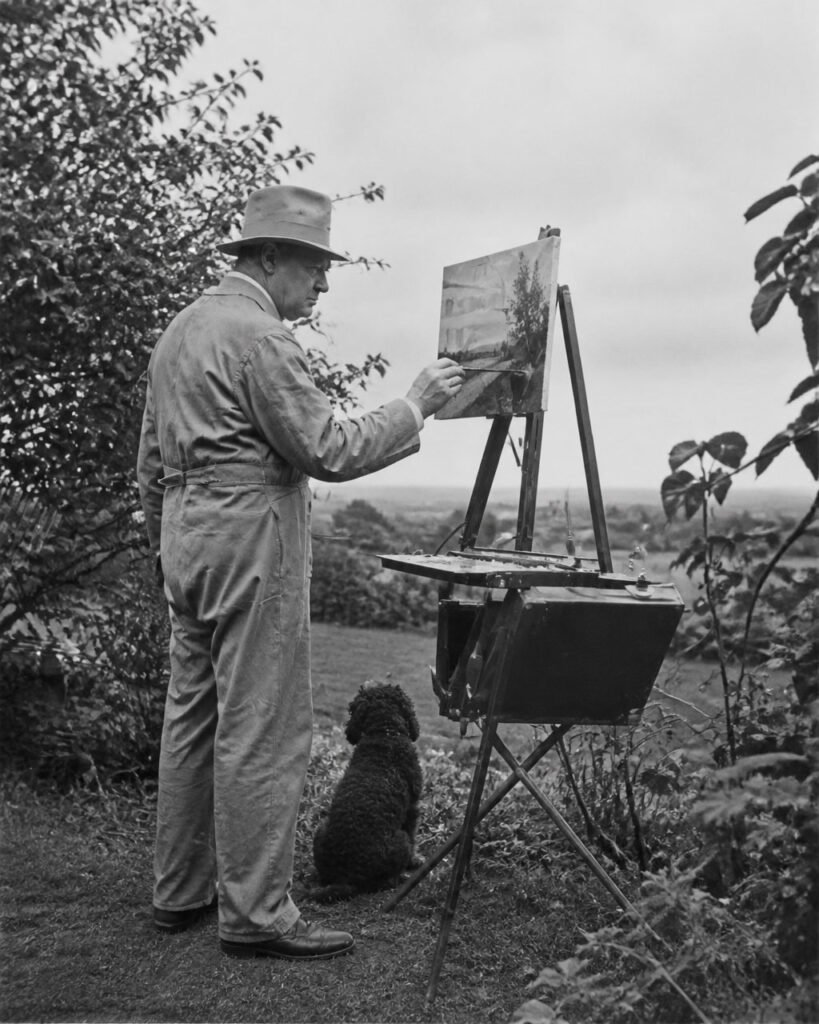
As I was mulling these newly clarified doubts, I cracked open a book I hadn’t touched since buying it on a recent visit to London: a collection of Winston Churchill’s paintings, with notes and letters about his artistic avocation.
In a 1911 letter to his wife, Clementine, he wrote of his “black dog,” his lifelong companion of anxiety and self-doubt. Sir John Rothenstein, Director of the Tate Galleries, quoted him as saying, “If it weren’t for painting, I couldn’t live. I couldn’t bear the strain of things.”
I sat there shaking my head, marveling that I had “spontaneously” picked up that book and opened to that page in the middle of my own struggle.
You are not alone, I told myself.
Then I remembered that I have helped nearly all my clients through some version of self-doubt. Is this simply another case of “we teach what we most need to learn”?
The Memo
Looking back, I can see that self-doubt has accompanied every big project of my career.
Early in my time at Disney, a memo arrived inviting me to a creative session with a roster of luminaries, including Rich Rothschild and Joe Rohde. I remember walking down that hallway feeling slightly sick to my stomach. These were legendary Imagineers, and I was sure I didn’t belong in the room.
I sat quietly through most of the first hour. Then, finally, I spoke up.
To my surprise, they welcomed my ideas. They were considered thoughtfully, built upon, taken seriously. The dread I had carried down that hall had told me nothing about the room I was walking into.
It was not the first time. As a young performer, I had such stage fright that someone literally had to push me from the wings into the spotlight. And when my first ghostwriting project was offered to me, it sounded like a mountain I had neither the constitution nor the skills to climb.

Each time, I acted despite the doubt. Each time, I found my footing.
So why does self-doubt persist? I have received so much encouragement about this project from so many people these past few months. How can I still harbor doubts?
The Turn
This morning I repeated a mantra I’ve practiced for some time: “Everything that arises serves to prosper me and my purposes.”
As I said it, I chuckled. Then I asked out loud, “How do my doubts prosper me and my purposes?”
The answer came immediately.
Doubts are indicators of value.
When I pick up a sketch pad to draw, I know I won’t create a work of art. And I’m not doubting my ability, because I don’t care enough to doubt.
Two weeks ago, I boldly took up the mantle to call forth this movement and declared my role in it, and the doubts crept in.
Because I care.
The possibility of restoring the wisdom of elders within our fractured culture inspires me and moves me to tears.
A possibility this big inevitably stirs up doubts, fears, resignation, cynicism, and all manner of mental mischief. That mischief could easily kill off a possibility before it saw the light of day.
With the help of my mantra I remember that Universe is for me, and I can make room for all of that mental mischief. The doubts are to be expected, even welcomed. They whisper, You’re onto something here.
Two Kinds of Doubt
But I don’t want to stop at the reframe, because not every doubt is only a signal. Some are also questions, and they deserve real answers.
The doubts about the project ask for inquiry, not reassurance. Is there sufficient interest? Does anyone care as I do? Caring tells me the project matters to me. It doesn’t tell me whether it matters to others. So I’m treating these as research questions: listening more, asking more, and letting what I learn shape what I build. Your replies to this newsletter are part of that research, and I read every one.
The doubts about age and health are the ones I most want to be honest about, because they are the elder’s doubts, and I suspect many of you carry them too.
Will my age and health hamper my capacity to see this through?
Maybe. I don’t have the boundless energy I had in my youth and during my career. I regularly wake up hurting in places I didn’t know I had places. A kidney transplant could easily take me out of the game for six months or longer.
I don’t think wisdom means talking myself out of that possibility. There is a limit to the time I have and to the energy I can bring, and pretending otherwise would be a small dishonesty at the heart of a project about wisdom.
But when I sit with the doubt instead of arguing with it, it asks better questions than it first seemed to. It asks what I most want to accomplish with the time I have. It asks whether I’m building something that depends on me alone, or something that can outlive my involvement. It asks who I might invite in, and what I should stop doing so that what matters most gets my full attention.
That last one is the legacy question, the same one I put to every person I work with in The Ancestor Initiative. If the elder movement is worth calling forth, it can’t rest on one person’s stamina. My limits aren’t an argument against beginning. They’re an argument for building well, and for building with others.
The Black Dog at His Side
Churchill is best remembered for telling a besieged nation, “Never give in,” and for the tenacity that helped lead the West to victory. I’m glad to know he did all of it with the black dog at his side. It was never gone. He learned to paint with it there.
Doubt may keep walking beside me, and it may walk beside you. But now I greet it differently. It’s not a verdict. It’s a compass needle pointing toward what I care about most.
So I’ll leave you with a question: Where is doubt showing up in your life right now, and what might it be telling you about what matters? Hit reply and tell me. I’d love to hear.
Shine,

Subscribe to the Newsletter
Join Max J Miller Blog and receive new online content directly in your inbox.
Recommended for Your Journey
Discover more inspiring reads that support your journey toward growth, purpose, and emotional well-being.
[001] – Is There LIFE Beyond…Your Bucket List?
- Max J Miller
[005] – Don’t Ask Me to Choose!
- Max J Miller
[053] The moment the entire camp went quiet
- Max J Miller
[056] The Beautiful: Why Truth That Rings Lasts Longer Than Truth That’s Right
- Max J Miller

[039] The Book Addict’s Guide to Peace
- Max J Miller

[043] The Wisdom He Didn’t Know He Was Teaching Me
- Max J Miller