Story #045
The Most Important Thing Wisdom Keepers Can Do Right Now

Max J Miller
What an extraordinary time to be alive!
Pause for a moment and notice what thoughts arise in your mind from reading this statement: What an extraordinary time to be alive!
For some, it may evoke the euphemistic curse, “May you live in interesting times.” They see what’s extraordinary about our epoch as a relentless wave of crises and disturbances.
For some, it may encompass the extraordinary advances in biology, chemistry, artificial intelligence, quantum computing, and fundamental physics taking place around the globe at breakneck speed.
Others, seeing both the crises and advancements, may recall Dickens’ opening line to A Tale of Two Cities: “It was the best of times. It was the worst of times.”
All three views affirm that indeed we are living in extraordinary times!
Like so many things in life, where your mind goes in response to this statement depends on which mental pathway you’ve trodden most consistently.
third act of life.
Until very recently and throughout human history, the elders have played a vital role as the wisdom keepers of the culture. Indigenous, Eastern, and Middle-Eastern cultures still look to the elders for teaching, guidance, and judgment. But, Western culture has excised the elders and amputated this crucial ancestor role in civilization.
Western culture has come to view retirement as a sort of finish line, not only for career, but for all meaningful participation in civic life. We’ve turned the third act into an exit ramp when it could be a launchpad.

But here’s what strikes me as most extraordinary: we stand at a crossroads where the very advances that could solve our greatest challenges are also the advances that most tempt us to outsource our thinking. Yikes!
AI can generate solutions. Algorithms can optimize decisions. Technology can automate creativity itself.
And yet.
The problems we face—social fragmentation, climate disruption, meaning crisis, tribalism—these aren’t primarily technical problems requiring technical solutions. They’re human problems requiring human wisdom. They demand something that can’t be coded or computed: the deep creative capacity that emerges when human beings reach into the well of their own experience, imagination, and shared humanity.
This is where we, the wisdom keepers, play our most vital role.
Not as the ones who have the answers. (I learned long ago that nobody wants to be lectured by someone who’s lived longer.) But as the ones who create the conditions for others to discover their own answers. As the gardeners who tend the soil where creative solutions can take root.
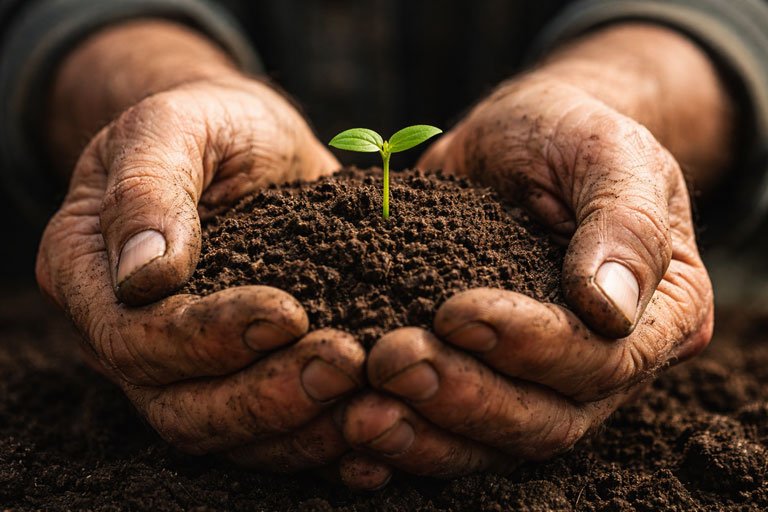
Our task isn’t to tell the younger generations what to think, but to model how to think when facing the unprecedented. To demonstrate that wisdom isn’t about accumulating right answers; it’s about developing the courage to sit with hard questions long enough for genuine insight to emerge.
This means encouraging others to:
Pause when the world demands speed. In a culture addicted to instant responses and hot takes, we can model the revolutionary act of not knowing yet, of creating space for reflection before reaction.
Look inward when every voice cries outward. The solutions to our collective challenges won’t come from more data, more experts, more noise. They’ll come from individuals brave enough to ask themselves: “What do I actually believe? What do I deeply know? What creative possibility am I uniquely positioned to offer?”
Trust the creative process when outcomes feel uncertain. We’ve lived long enough to know that the path from problem to solution is rarely linear. The messy middle, where confusion reigns and nothing seems to work, is often where the breakthrough is germinating.
Draw from wells deeper than information. We carry decades of lived experience, failures survived, mysteries pondered, and beauty witnessed. This isn’t nostalgia; it’s the raw material of wisdom. And in sharing our stories authentically (not as prescriptions but as possibilities), we remind others that they, too, have access to inner resources they may have forgotten.
The extraordinary opportunity of this extraordinary time is this: We can help humanity remember that the most powerful technology we possess isn’t artificial—it’s the natural human capacity for creativity, meaning-making, and transformation that has carried our species through every previous era of upheaval.
Our role as elders isn’t to have weathered the storm and returned with THE map.
It’s to have weathered many storms and returned with the confidence to say: “You have everything you need within you. Now dig deep. Get creative. Trust yourself.”
That’s what makes this an extraordinary time to be alive, and an extraordinary time to be a wisdom keeper.
Shine,

Subscribe to the Newsletter
Join Max J Miller Blog and receive new online content directly in your inbox.
Recommended for Your Journey
Discover more inspiring reads that support your journey toward growth, purpose, and emotional well-being.

[011] – Why Writing Advice is Mostly Wrong
- Max J Miller

[044] The Finish-Line Fallacy
- Max J Miller

[046] Finding My Voice by Losing It First
- Max J Miller
[047] Finding Your Voice (It’s Already There)
- Max J Miller

[013] – Men, Loneliness, and the Power We’re Not UsingWe’re Not Using
- Max J Miller
[033] Living the Questions: My Spiritual Story Begins
- Max J Miller