
Story #036
When I Lost My Beliefs, I Found My Faith

Max J Miller
When I announced at age 47, I was returning to finish my Bachelor’s Degree in Religious Studies, I got some surprised and concerned reactions.
If you’ve been following this series on My Journey of Faith, you may be surprised by that decision as well. In the previous three editions, I mapped my relationship with God over the story arc of a classic Rom-Com. We left off just as the relationship was tanking.
In this fourth installment, I want to share how my relationship with God bottomed out and then rose to unprecedented heights.
So when I told people about my plans, many friends asked questions like, “Are you going into the ministry?”
One of my friends expressed serious reservations about my choice to attend a secular university. “Why don’t you go to Fuller Seminary? It’s right here in Pasadena, and it’s a Christian school.”
“You sound concerned.” I said, “Why do you suggest that I go to Fuller?”
“Well, I think Fuller would nurture your faith better than a university would.”
I appreciate that this friend was concerned for my well-being. His attitude toward secular education reminded me of a church sign I had seen:
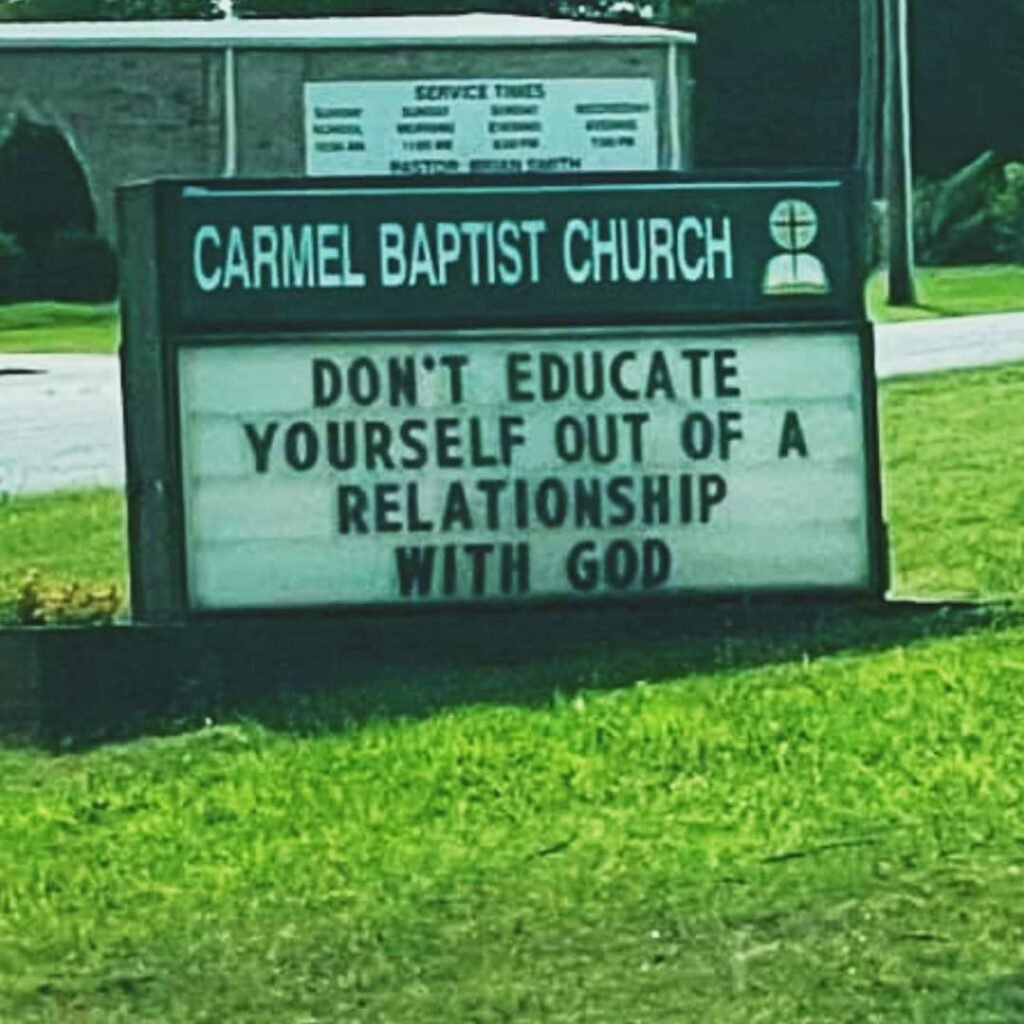
My friend had no idea how far down the path of disbelief I had already travelled. His reaction gave me insight into my own crisis of faith. These doubts weren’t new.
In fact, I was in the throes of a midlife crisis arising at the junction of three life quandaries: in addition to my doubt-riddled faith, there was my unfulfilling career and my lack of purpose.
Thinking I’d continue to graduate school and pursue a teaching career, I chose to major in Religious Studies. At a secular university, this degree is a hybrid of sociology, anthropology, and history. Unlike theology or divinity, Religious Studies is not concerned with the truth or falsehood of religious claims and beliefs. Instead, it’s an attempt to understand the human experience of religion. Clearly, I was trying to better understand my own experience.
For years, I had wrestled with doubts about my faith. It bothered me, for example, how Christians rejected science in every instance where it conflicted with their understanding of the Bible. I was horrified by how Christians had used scriptures through the years to justify slavery, racism, patriarchy, and all sorts of injustice. It was all rationalized by citing the Holy Scriptures.
As a culture, we generally conceive of faith as fundamentally distinct from, and in many ways, opposed to reason. Those who consider themselves “believers” buy into this distinction, though they often try to downplay the conflict by reframing it: “faith transcends reason,” or “God’s ways are higher than our ways.”
And though these reframes suggest humility, they conceal a fundamental corruption of faith.
I hear people speak about “defending their faith,” But the slightest bit of probing usually reveals that they are defending their beliefs.
Aren’t faith and belief the same thing?
After the long, winding journey I’ve described in the last three Wisdom Wayfinders, I came to the conclusion that belief and faith are not remotely the same. Faith is a practice of trusting and persisting in righteous behaviors. Belief is holding to an idea or a point of view. And beliefs often serve as a smokescreen for an absence of faith.
Where beliefs are clear and defined, faith is full of awe and wonder.
Belief asks, “Do you believe in original sin? Do you believe God created the world in a week? Do you believe in Heaven and Hell?” These beliefs all relate to the past or the future.
Faith looks at a clear night sky and asks, “How is it that there’s anything instead of nothing? How are we here on a tiny rock floating in a universe with billions of galaxies?” Faith is a quality of being in the present.
I love Albert Einstein’s observation, which he wrote in a letter to a friend: “There are two ways to look at life: either nothing is miraculous or everything is miraculous.”
When people say that religion is the root of all wars and conflict, I tend to agree, but I want to point out that people are fighting for their inherited beliefs and tribal traditions, not their faith in God.
Previously, I’ve shared my misgivings about how the followers of Jesus—who commanded ‘love one another’ and ‘forgive one another’—have splintered into over 45,000 distinct denominations. How do you explain this two-millennia history of nonstop division as manifestations of the same faith?
Like the Psalmist who exhorted, “Lean not on your own understanding,” I sense Jesus saying, “Your sin of certainty kills off your love.” And if God is love, your arrogance may extinguish the presence of the divine as well.
But we’ve conflated faith and belief for so long that the distinction is nearly invisible. If you suggest that Christians are interpreting the scriptures according to inherited presuppositions and preexisting bias, they will protest that they are merely reading what the text actually says. Belief and interpretation are inseparable.
During this period, a Christian friend of mine told me that he found a church that was “just like the early church.”
“So they don’t have a bible?” I asked him, “And they don’t recite any creed, right?”
“What are you talking about?” He replied, “We honor the Bible as God’s holy word.”
I pointed out, “The early church didn’t have any part of what we call the New Testament. That came together centuries later. And the creeds came hundreds of years after Jesus, too.”
Okay, I revealed a bit of the ‘Anger stage’ of my grieving process. This is the part of the Rom-Com where the boy gets angry or frustrated, then runs back hoping to salvage his relationship.
I found myself annoyed by anybody’s assertion of beliefs. I grew frustrated with the whole “I’m right and you’re wrong” aspect of religious belief.
When Jesus said, “Repent for the kingdom of heaven is at hand,” all God’s people assumed he was speaking to all the other people. (Repent means change your mind.)
“No, you change your mind!” And the battle ensues.
I recognize that I was acting like the guy who just quit smoking and now shames everyone who still smokes.
This phase of my journey of faith was very messy. I lashed out at times when I was really wrestling with my own inner turmoil. I was afraid. I thought that all my doubts and fears were threatening my own identity.
One day, a lightbulb went off: I’m not the only one who doubts and questions. With 45,000 denominations and theological debates raging inside every congregation, we’ve each been finding our own way through this grand mystery all along the way. Each of us is our own theologian.
And why not? Wrestling with the great mysteries is essential to our nature. That may be the quintessence of the ‘image of God’ we are supposed to embody. As Douglas Adams declared in A Hitchhiker’s Guide to the Galaxy, “Let us think the unthinkable, let us do the undoable, let us prepare to grapple with the ineffable itself, and see if we may not eff it after all.”
Somehow, that lightbulb moment gave me the courage to face my fears and to question the beliefs I had inherited from my church communities.
Close friends of mine told me this process is ‘deconstruction,’ and they described it almost universally as a ‘letting go of faith.’ For me, this process lasted over a decade and had a surprising effect. I let go of virtually all of the beliefs that Evangelical Christians call “fundamentals,” not anticipating what would spring up in their place.
Though many folks have been through their own version of deconstruction, letting go of beliefs is a lonely experience. In the process of grief, a period of sadness slowly gives rise to acceptance. For me, acceptance emerged slowly like the faint light of a new dawn.
There was a quiet stillness in my spirit at this time. I didn’t have explanations and answers for what was happening, but I had so many sweet moments when I felt connected to the natural world, to other people, and surprisingly, to God.
A new awareness of spirit washed over me again and again. Strangely, so many verses of scripture came to mind that I now found more meaningful, such as the description of God appearing as a still, small voice.
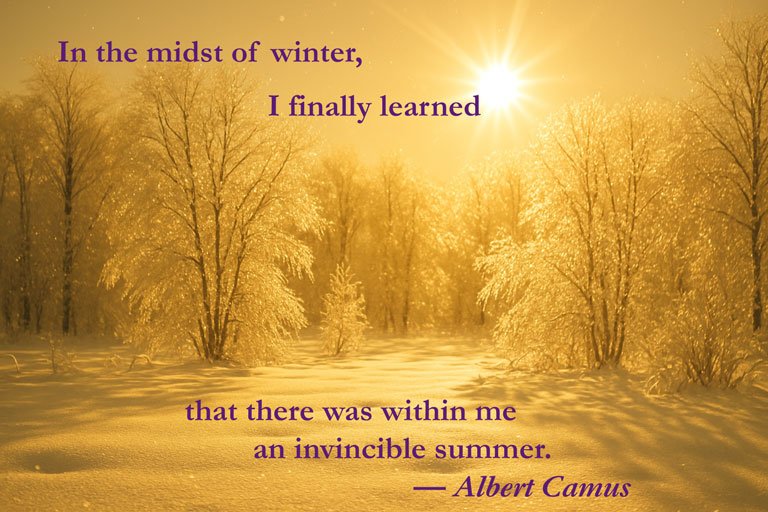
I came across a quote by Camus that resonated deep within my soul: “In the midst of winter, I finally learned that there was within me an invincible summer.”
I no longer feel any impulse to defend or even articulate beliefs. I still read my Bible with curiosity and a seeker’s heart, just as I read Buddhist sutras and Hindu and Taoist writings.
When I feel doubt or anxiety, I reach for ancient wisdom rather than today’s news. My new motto is “Stop the scroll, and pick up a scroll.”
While my beliefs have diminished, my faith has flourished.
I trust in an ineffable mystery.
Shine,

Subscribe to the Newsletter
Join Max J Miller Blog and receive new online content directly in your inbox.
Recommended for Your Journey
Discover more inspiring reads that support your journey toward growth, purpose, and emotional well-being.

[004] – Am I Broken?
- Max J Miller

[020] – A Middle Child’s Wisdom for a Fractured World
- Max J Miller

[043] The Wisdom He Didn’t Know He Was Teaching Me
- Max J Miller

[007] – I Spy With My Little Eye…
- Max J Miller
[001] – Is There LIFE Beyond…Your Bucket List?
- Max J Miller
[010] – What Am I Doing Here?
- Max J Miller