
Story #020
A Middle Child’s Wisdom for a Fractured World

Max J Miller

A Middle Child’s Lament
Before my folks divorced, I had one older brother and a younger sister. After my mom remarried, I gained another older brother and an additional younger sister. So much for escaping the middle child slot—there I was, stuck right back in it.
I remember sitting on the stairs, just out of sight, listening to the muffled voices of yet another argument—waiting for the moment when someone would slam a door. When the tension cooled, I’d slip into my role: part negotiator, part comic relief, always trying to stitch the family back together.
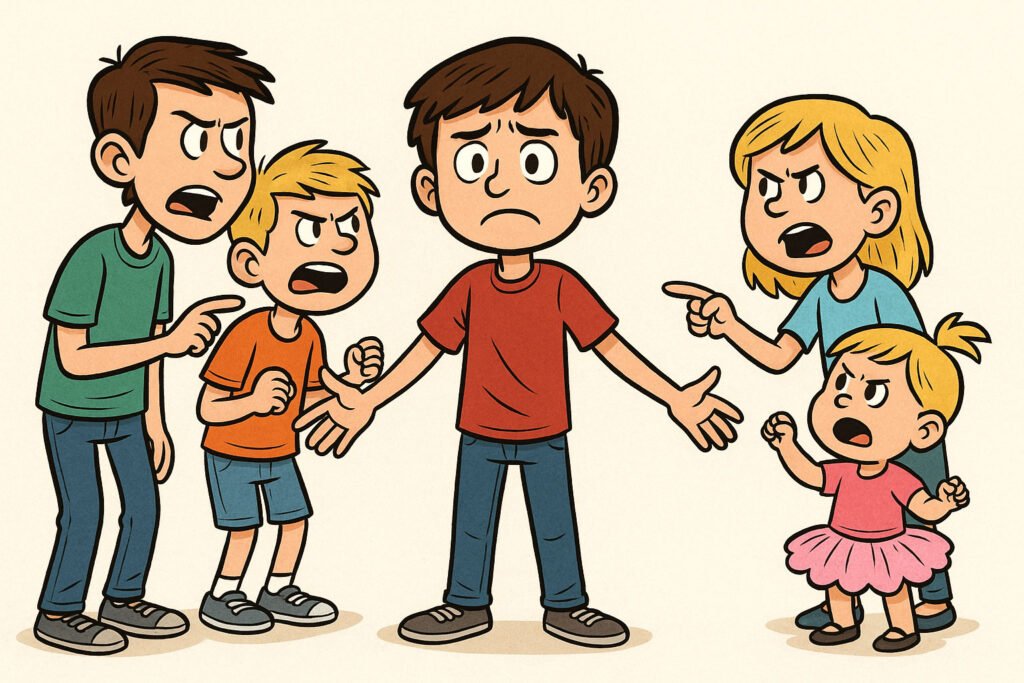
Later in life, I learned that middle children often have a special portion of “perspective taking,” the ability to experience another person’s point of view. This can be both a blessing and a curse.
Perspective taking generally aids communication, empathy, influence, leadership, and peacemaking.
However, it can be alienating in heated situations when opposing parties just want you to “pick a side.” Ironically, the very gift of perspective-taking often makes us indecisive—seeing every side can paralyze you. (Check out my decision-making breakthrough in Issue [005].)
In my experience, the worst aspect of the ‘middle-child syndrome’ has to do with internalizing the tension of unresolved family squabbles.
The middle child laments, “Why can’t we all just get along?!”
For many of us, that conflict sensitivity extends beyond the family domain. We stress over conflicts among friends, communities, and beyond.
In the early 1980s, my church experienced a theological battle that resulted in one faction splitting off to form a new church. The controversy that tore the community apart was whether a woman could be promoted to a church leadership position.
Having belonged to this church for barely a few months, I chose not to openly “take a side” in the debate. Although I mainly identified with the group favoring full participation for women, I appreciated the arguments of the ‘traditionalist’ members.
Maybe it was the middle child thing, and maybe it was youthful arrogance (I was 24), but I finally got up to speak at one of the church meetings.
Stepping up to the lectern, my heart pounded so hard I could barely hear my own voice. Faces turned toward me—some curious, some skeptical, some openly hostile. I remember clutching the edge of the podium for courage as I spoke. I wasn’t trying to win; I was pleading, with every fiber of my 24-year-old self, for us to remember what mattered most: love.
The gist of my little sermon was to remind the congregation that the Christian church had fractured into 40,000 different denominations (no exaggeration) despite Jesus’s indisputable primary command that we “love God and love one another.”
Church history tells us that the vast majority of those denominational splinters resulted from disagreements about doctrine (interpretations of biblical teachings).
Man’s utter incapacity to work out our differences of opinion without violence leaves this middle child profoundly discouraged at times. The fact that those who claim to be followers of Jesus are no different from the rest of our tribal species brings me to despair.
The Christian ideal has not been tried and found wanting. It has been found difficult; and left untried.
– G.K. Chesterton
What’s Wrong With The World (1910) Part One: The Homelessness Of Man, Ch. 5: The Unfinished Temple
If you stand back and look intently into the strife in our world—between siblings, neighbors, political factions, or countries—you’ll find the same human pattern at work. We prioritize defending our perspectives over everything else. We call our perspectives beliefs, faith, opinions, reality, truth, among other terms.
But the curse that overshadows humanity, what this middle child considers our actual “original sin” that lies at the root of all our most significant troubles, is misunderstanding. Not ignorance, but arrogance.
It ain’t what you know that gets you in trouble—it’s what you know for sure that just ain’t so.
– Artemus Ward
(popularized by Will Rogers and often mis-attributed to Mark Twain)
Arrogance is the essence of many cautionary myths, including Pandora’s box and Adam and Eve eating from the Tree of the Knowledge of Good and Evil.
That very human fight-to-be-right impulse costs us dearly: to be right, we sacrifice love, peace, prosperity, joy, happiness, and fulfillment.
For a middle child, the fractured and embattled world sometimes seems utterly hopeless.
And yet, just when the world feels irreparably splintered, I notice something remarkable in my own life, and in the lives of other elders I know. With age, the need to be right softens. The craving for connection grows louder. We begin to see through others’ eyes, not just our own. Perspective-taking is no longer a survival tactic of the middle child; it becomes the hard-won wisdom of the elder.
You may recall that there’s a bit of hope left at the bottom of Pandora’s box after all the evils it contained have escaped into the world. We are that hope.
The world doesn’t need more opinions shouted into the void. It needs wise voices willing to listen, to bridge, and to heal. If there is a path out of the morass humanity currently finds itself in, we, the cultural elders, are the ones to blaze that trail.
In our third act, we are uniquely poised to offer that—not as bystanders but as peacemakers, as elders, as those who have suffered the cost of division and now dare to offer something better.
If we have the courage to do so, we can challenge the arrogance on all sides. We are the ones who can call people back from the brink of strife and the hell of war.
This is our time to stand in the gap. To call the world back to love.
And blessed are the peacemakers. (Mt. 5:9)

Subscribe to the Newsletter
Join Max J Miller Blog and receive new online content directly in your inbox.
Recommended for Your Journey
Discover more inspiring reads that support your journey toward growth, purpose, and emotional well-being.

[043] The Wisdom He Didn’t Know He Was Teaching Me
- Max J Miller

[008] – Charlie Hustle, Street Theater, and the Soul of Story
- Max J Miller

[011] – Why Writing Advice is Mostly Wrong
- Max J Miller

[004] – Am I Broken?
- Max J Miller

[026] Celebrating Six Months of The Wisdom Wayfinder!
- Max J Miller
[029] Alignment: Finding Common Ground Without Agreement
- Max J Miller