
Story #006
Climbing Jacob's Ladder

Max J Miller

Climbing Jacob's Ladder
“You want to perform with us at the Renaissance Festival?”
Just the year before, my friend Terry and a couple of his buddies had started a street-theater troupe they called “SAK Theatre,” and they were attracting huge crowds at the festival. I saw them perform that first year, and it was hilarious.
They gathered a crowd by a combination of rowdy, almost slapstick humor and loud, outrageous banter. When they had a small audience, one of the performers would begin telling a familiar story, such as Cinderella or Romeo and Juliet.
As soon as the storyteller introduced the first character, one of the other performers would adorn an unsuspecting octogenarian with a makeshift cape and proclaim him, “Romeo!” Soon, he was matched with a matronly “Juliet,” and the madness began.
I was enthralled by the comic and improvisational skills of these performers, and I fantasized that I might one day join them.
Here it was, only a year later, and I was being invited to join this merry band of thespians.
“What do I have to do?” I asked eagerly. “Can I start learning the scripts?”
“We don’t have scripts,” Terry replied. “You’ll have to learn the shows by watching. It’s mostly improvisation.” Truth be told, that terrified me, but it was also exhilarating.
It seems Terry could sense my anxiety. “You won’t perform for at least the first couple of weekends of the festival,” he assured me. “You’ll just watch shows and run Jacob’s Ladder.”
“Jacob’s Ladder? What’s that?”
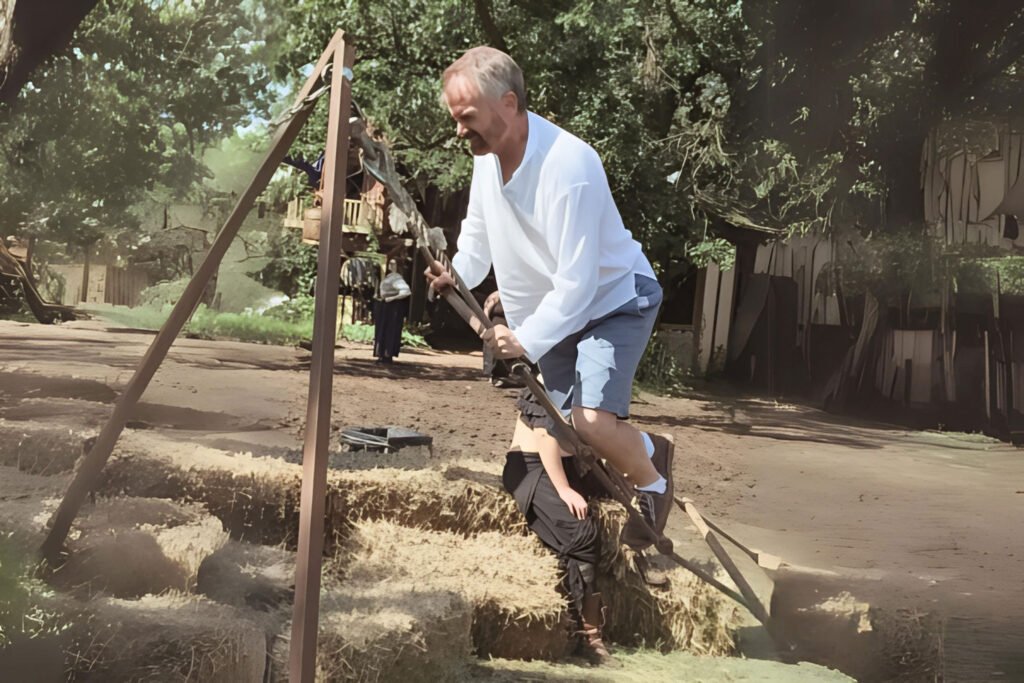
(Me climbing the ladder at SAK Theater’s 40th anniversary reunion in 2017.)
“That’s how we make money, in addition to passing the hat after each show,” Terry said nonchalantly. “You’ll have to learn how to climb the ladder, so we’ll have a training next weekend.”
Jacob’s Ladder is a skill-based midway game that looks deceptively easy. It’s a rope ladder placed on an angle (see the picture above), attached to a well-greased industrial swivel at each end.
Guests pay one dollar for three tries to climb the ladder, ring the bell at the top, and win five dollars if successful. Few collected the prize.
The game draws a crowd because most who try fail, and the bolder the attempt, the more comical it appears. Each in succession lands unceremoniously in a pile of hay below the ladder.
Jacob’s Ladder served as a perfect training ground for street-theater performers. We transformed it into a wildly engaging show, and, just like our regular performances, the entertainment value stemmed from audience participation, making them the stars of the show.
The hook came from our periodic demonstrations of how easy it is to ascend the ladder. After watching a series of spectacular pratfalls followed by a skinny performer lithely slinking up and ringing the bell, some “dude” would inevitably push through the crowd and declare he knew the ‘secret.’
After paying his dollar, he would take the ladder for a proverbial “spin.” Keep in mind, a Renaissance festival doubles as a giant outdoor bar.
You may wonder how we made it look so easy. We tortured ourselves for several days to master the counterintuitive moves. The instructions were simple:
1. Put your opposite foot and hand in place at the same time and find your balance. (That took a whole day to master.)
2. When you feel yourself leaning to the left, push down on the right. (This is the opposite of all your instincts.)
3. Keep your center of gravity low (keep your ass down).
4. Gently shift your weight to the opposite arm and opposite foot simultaneously. (That took another couple of days to make the first successful shift.)
5. Repeat #4 three more times.
6. Ring the bell when you get to the top (and before you fall).
They didn’t tell me that I would wear out all the muscles in my arms and legs and bruise my hands, elbows, knees, shins, and of course, my ass (from landing on it three hundred times in a day).
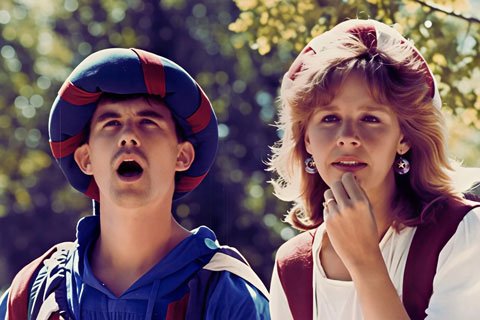
(This is me performing SAK’s Big Bear Show with my dear friend, Bernelle.)
Five prospective performers started training with me that weekend. Only two of us completed Jacob’s Ladder Bootcamp. The others were invited to return and try it again another time.
What kept me going through this grueling ordeal was the idea of sharing the “stage” with these talented street performers.
That evening, as we celebrated our welcome into the SAK troupe, I thought back to when I first learned to ride a bicycle. My brother, who was a year older than I, had been riding for almost three years by the time I took the training wheels off my bike.
I remember how frustrating it was to watch him and all my friends ride and pop wheelies while I was still trying desperately to find that elusive magic called balance.
Back at boot camp, I was icing my bruised and scraped knees. I wondered, ‘Why is it so challenging to learn to balance?’
That led to a more philosophical question: “What exactly IS balance?”
I looked back over the past three days. What happened? What did I learn, really?
I learned to recognize when I was about to fall and respond immediately but gently.
Then a lightbulb went on.
Balance is a finely tuned awareness of falling.
That’s it.
Then the second lightbulb flashed.
How do you develop a finely-tuned awareness of falling?

By falling.
However, it helps if I fall without judgment, with minimal upset, and with complete confidence that balance will inevitably arise from the practice of falling.
“The ability to observe without evaluating is the highest form of intelligence.”
– Jiddu Krishnamurti
This opened up a new world for me. It changed my relationship to “failure” from one of resignation to something closer to determination. Each “fall” is training that leads me closer to balance.
Shortly after this Bootcamp experience, but long after the notorious airport meltdown incident (issue 004), I was driving away from my home, and I suddenly remembered something. I slapped my forehead and cried, “Ugh! I forgot my wallet…again.”
Then, I reconsidered and had a heart-to-heart with myself. “Why are you slapping your head at the very moment you remembered? Don’t punish yourself for remembering.”
I remembered what Patricia McDade, one of my mentors, said: “You get what you measure for, so take care to measure for what you want, not for what you don’t want.”
As the gospel hymn goes, “We are climbing Jacob’s ladder. We are climbing higher, higher.”
Let’s remind ourselves to keep reaching for the next rung of the ladder and recognize that falling is a natural part of the process on the way to eventually ringing the bell and winning the game.

Learning Without Judgment
The ‘falling as access to balance’ metaphor applies to so many aspects of life.
What is mindfulness but a keen awareness of thoughts and emotions arising? After attempting to start a meditation practice, I finally learned that noticing my wandering mind was the essence of the practice, not a sign of failure.
What is good decision-making, but a well-earned awareness of bad decisions?
What is concentration but a finely-tuned awareness of distractions?
What is good communication, but alertness to the pitfalls of communication?
What is intimacy and affection but a humble awareness of judgments and other mischief that smothers the flame?
However, in each of these cases, I’m learning, we gain a deep and practical awareness by noticing without judgment and without upset.
This quote seems to summarize my discovery:
“Life is too ironic to fully understand. It takes sadness to know what happiness is. Noise to appreciate silence & absence to value presence.”
― Abhysheq Shukla
As the elders of the tribe, let’s be gentle with ourselves as we continue to gain balance and wisdom from our falls and mistakes. And let’s find ways to pass on that patient, gentle spirit to our tribes so we may all take risks to grow and learn.
Cheers,

P.S., What other examples do you find that follow the “falling as access to balance” metaphor? Hit reply, and let me know your thoughts.
P.P.S., Next week I’ll be adding a new section to The Wisdom Wayfinder called Ideas Worth Shredding. You won’t want to miss it.
P.P.P.S., If you ever saw the street performers at EPCOT (Italy or UK), you probably saw SAK Theater. Collectively, we performed over 40 shows each day for six years.
Subscribe to the Newsletter
Join Max J Miller Blog and receive new online content directly in your inbox.
Recommended for Your Journey
Discover more inspiring reads that support your journey toward growth, purpose, and emotional well-being.

[034] Finding God in forbidden love—then facing intervention
- Max J Miller

[007] – I Spy With My Little Eye…
- Max J Miller

[043] The Wisdom He Didn’t Know He Was Teaching Me
- Max J Miller
[047] Finding Your Voice (It’s Already There)
- Max J Miller

[039] The Book Addict’s Guide to Peace
- Max J Miller
[035] Standing Outside the Window: When Spiritual Love Turns Hollow
- Max J Miller