
Story #005
Don't Ask Me to Choose!

Max J Miller

Don't Ask Me to Choose!
After participating in a seminar I was leading, a couple approached me to express interest in discussing a possible book project. I suggested we meet over a meal. We agreed on an evening and I invited them to choose the restaurant.
They suggested Jerry’s Deli. My heart sank.
Jerry’s Deli, where the menu wasn’t just long—it had its own table of contents, three appendices, and required its own ZIP code.
I struggled with most decisions. As far back as I can recall, I was the last person to order in any restaurant. And it took me three whole days at a car dealership to buy my first car.
I wanted to be present with my new friends, so I determined to avoid the struggle. I chose the first item I saw: a beautiful Cobb salad. “It must be popular,” I told myself. “They put it right on the menu cover.”
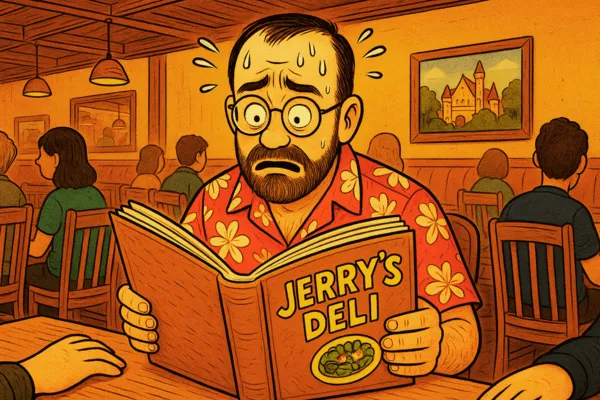
My decision was made. I looked up and realized everyone else was still undecided. So I opened the menu and quickly scanned other items, asking, “Is anything more appealing than a Cobb salad?”
The binary choice I had set up made the comparison easy, and in a minute, I was five pages through the menu. Then, I spotted a Reuben sandwich. That was the first item that struck me as more appealing than a Cobb salad.
Then I perused the rest of the menu, asking, “Is anything better than a Reuben sandwich?” I was done with the whole process in less than two minutes.
I looked up, delighted with my Reuben selection. At the same time, my friends were still engaged in what appeared to be deep philosophical negotiations with their menus, as if deciding the fate of nations rather than dinner.
Hmm. I had stumbled upon something that might have wide application in decision-making. I call it binary decision-making.
Years later, my partner and I moved from L.A. to Washington, DC. We went on a quick trip to find a place to live. He would be in meetings all day, so I went to see homes with a Realtor. We had made a list of “must-have” and “nice-to-have” criteria. In less than three days, I saw 25 homes, and based on my list of criteria, I narrowed it down to five finalists.
Then, one evening, I returned with my partner to see the five contenders. I used my binary decision-making process to prioritize the five finalists in reverse order of preference.
We took my partner to my least favorite of the five, then to my next-to-least favorite.
After he saw the first two finalists, I asked him which one he preferred (without revealing my preferences).
He chose the second one. “So, let’s forget about the first house you saw. You prefer this one over that one. Let’s move on.”
We continued to my #3 choice. Again, I asked my partner which house he preferred. He hesitated and verbally discussed the pros and cons of each.
Then, I asked, “Between this one and the last one, which do you prefer?”
“I’ll have to go with this one.”
Again, we agreed, but I kept my poker face on.
Then we saw my #2 choice. Again, he took his time to ponder his decision. He revisited the kitchen and a room he identified as “his office.”
Once again, he chose #2 over #3. Now, we’re cooking with gas!
Finally, we went to my #1 favorite house. At this point, it was challenging not to talk about my preferences.
One interesting thing about the final two homes is that they were directly across the street from each other. We went back and forth several times, and I could tell he struggled with this final decision.
I had made my peace: despite my preferences, I would have been delighted with any of the last three.
Finally, he said, “Let’s go with the red brick.” (That was my second choice.)
I said, “Great! Let’s make an offer.”
The Realtor checked his watch three times. I wondered if he had another appointment. I asked him, “Do you need to do something, or can we write up an offer tonight?”
“Of course, we can write up an offer,” he said, sounding perplexed. “I’m just awe-struck that you two made a mid-six-figure decision in less time than it takes most people to choose a breakfast cereal.”
Frankly, I was amazed as well.
They say choices are the hinges of destiny, but nobody mentioned these hinges would squeak so loudly.
Today, I no longer stand frozen in front of restaurant menus or spend weeks agonizing over which shade of white to paint the bathroom.
My binary decision-making method has given me back countless hours of my life—hours I now spend helping friends choose between perfectly good options while they look at me like I’ve discovered fire.
My sister had the same malady and dreaded taking her three young boys anywhere that would involve decisions. She called me in tears one day. “The boys and I are at The Magic Kingdom, and we can’t make up our minds what to see in what order.”
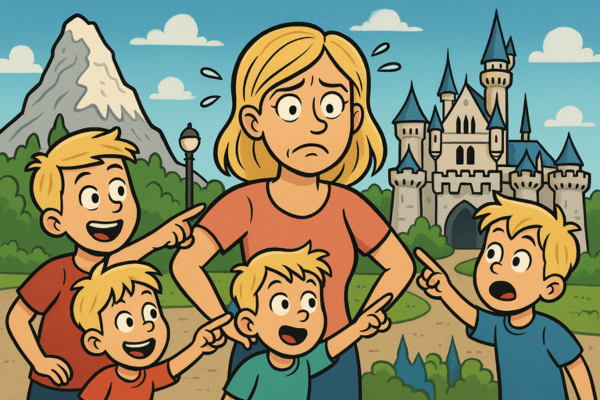
I gave her the cram course. “Ask the boys, what’s the one thing we must see today?
They all agreed on Space Mountain. “Good,” I said, “Go there now.” When you get out, ask the question again.
That night, she called me exhausted but giddy. “It worked amazingly well! They had the time of their lives, and I never got so much exercise in one day.”
I don’t recommend using this for the first time on a significant life decision. Start small–what’s for dinner tonight?
And if you’re wondering whether to try this method yourself or continue your relationship with decision paralysis, I’ve already narrowed your options down to two. Choose wisely… or quickly… or both!

Don't Sweat The Small Stuff...Like Decisions
Many people report that decision-making grows increasingly difficult as they age
I used to agonize over making decisions, no matter their importance
But now, decision-making feels like a superpower.
I’ve shared how I discovered the power of “binary decision-making.
Years later, having taught my method to untold indecision sufferers, I discovered that brain science research validates the basis of binary choices. The brain bogs down with as few as three options.
Another researcher demonstrated the effectiveness of using logic first to analyze the field of choices, followed by making a ‘gut’ decision. That’s precisely what I did when we bought the house. We made a list of criteria and narrowed our choices based on that. Then, we made our final choices with our gut.
Why logic first and then gut
When we make complex decisions, we can’t control all the possibilities. We are never 100% sure we are making the “right” choice. We don’t know the future, and shit happens, right?
Take buying a house. You think it’s perfect for you. And six months after moving in, you have to replace the furnace.
If we followed all logic and didn’t trust our gut in the final choice, we would regret it. We would say things like, “I should have checked that,” or “I had a feeling, and I didn’t listen to it.”
If we went with our gut, we would make space for whatever comes up and even justify it. We would say things like, “That’s a bummer, but I love this place, and it’s still worth it. We made the right decision.”
Do you think you’ll still struggle with making a ‘gut’ decision? Here’s a poem that might help by the late Danish scientist and author, Piet Hein:
A Psychological Tip
Whenever you’re called on to make up your mind,
and you’re hampered by not having any,
the best way to solve the dilemma, you’ll find,
is simply by spinning a penny.
No—not so that chance shall decide the affair
while you’re passively standing there moping;
but the moment the penny is up in the air,
you suddenly know what you’re hoping.
I hope you choose wisely, freely, and happily.
Cheers,

Did you receive The Wisdom Wayfinder from a friend?
Subscribe now for FREE—Click HERE.
P.S. I’m considering creating a free, brief masterclass on giving a toast, a short talk, or even a eulogy that puts you and your audience at ease and gives them the warm fuzzies. Would that be of interest to you? If so, please click here.
Subscribe to the Newsletter
Join Max J Miller Blog and receive new online content directly in your inbox.
Recommended for Your Journey
Discover more inspiring reads that support your journey toward growth, purpose, and emotional well-being.
[012] – Why I’m grateful for my 20-year detour
- Max J Miller
[015] – A Call to Reinvention
- Max J Miller

[018] – An Elder Manifesto
- Max J Miller
[003] – Question Everything
- Max J Miller

[044] The Finish-Line Fallacy
- Max J Miller

[002] – The Surprising Seed of Wisdom
- Max J Miller